due-diligence
Investor data room
Investor Pitch
Fundraising
Data Room
Funding Tips
Google Drive Is Not a Data Room: Better Startup Data Room Alternatives

Adhrita Nowrin
Mar 11, 2026
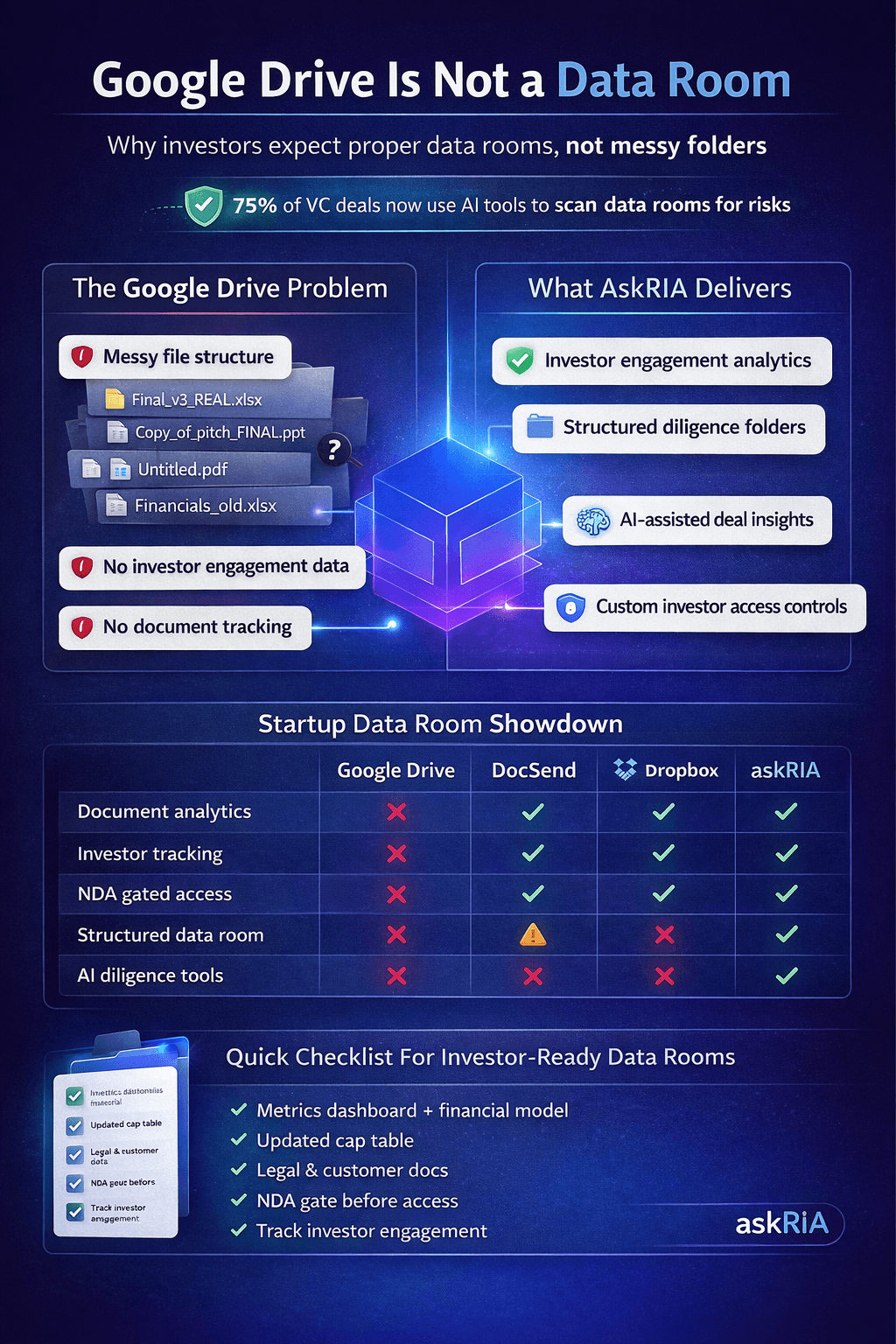
An angel investor we know passed on a deal within 90 seconds last month.
The founder had sent a Google Drive link with 34 files, no folder structure, and a financial model named "Copy of Final_v3." She closed the tab. The founder couldn't figure out why.
This happens more than most people admit. Google Drive is a collaboration tool. It was built for real-time editing and sharing docs with a co-founder at 1am. It was not built for fundraising diligence.
A data room (also called a virtual data room or VDR) is a secure, structured document repository built specifically for fundraising and due diligence. Unlike a shared folder, a proper data room helps founders organise materials and track engagement, while giving investors a faster way to evaluate deals. Google Drive does neither. This post covers what's broken about Drive, how the alternatives compare, and what actually happens when diligence runs on infrastructure built for the job.
Why Google Drive fails as a data room (and what each side actually needs)
When a founder shares a Google Drive link, they have no idea what happens next. Did the investor open the folder? Did they look at the financial model or stop at the pitch deck? Are they still interested, or did they close the tab 90 seconds in? Drive gives founders zero visibility into investor behaviour. There is no engagement tracking. No way to know who's active and who's gone cold.
Beyond tracking, Google Drive doesn't tell founders what's missing from their materials. Most first-time founders don't know what a proper data room looks like. There's no feedback mechanism, no structure enforcement and no way to know whether the financial model ties to the bank statements, or whether the cap table is clean enough for diligence. Founders using Google Drive are flying blind.
Investors on the other hand, care about evaluating deals quickly. When an angel or a fund manager receives a Google Drive link, they open a folder with 20 to 30 files and no logic to the organisation. The cap table might be in a subfolder called "Legal" or in the root directory named "Cap_Table_v2_FINAL." The financial model might be an Excel file, a Google Sheet, or a PDF export.
According to Gartner (2025), 75% of VC deal reviews are now AI-informed. Investors increasingly feed data rooms into AI tools that parse, score, and flag issues. A Google Drive folder full of randomly named PDFs can't be parsed by those tools. The investor is left doing everything manually.
At 50+ deals a month for a typical angel, manual evaluation of every Google Drive link is not realistic. Most investors spend less than 5 minutes before deciding whether a deal is worth more time.
The result ultimately is that, founders lose deals not because of their company, but because their data room made evaluation too hard.
Data Room Alternatives for Fundraising
📊 Data Room Alternatives for Fundraising (2026)
Platform
What it does for founders
What it does for investors
Price
The gap
Google Drive
File storage and sharing.
View PDFs. Nothing else.
Free
No tracking, no structure, no scoring, no communication
DocSend
Tracks who viewed documents, time per page. NDA gating on higher plans.
View documents with access control
$10-$180/mo
Tracks who viewed. Doesn't help investors evaluate. 100-view cap on basic plan.
Dropbox
File storage with decent security
View and download files
Free-£10/mo
A filing cabinet. No analytics, no structure, no evaluation.
Ansarada / Intralinks
Enterprise-grade audit trails, compliance
Due diligence workflow management, AI insights and deal analytics
£15,000+/year
Built for £50M+ M&A.
askRIA
Structured data room built automatically. Identifies missing documents. Investor readiness score. Red flag detection. Tracks engagement.
Automatic question extraction from uploaded docs. Deal scored against custom thesis. Red/green flags surfaced. Agent asks founder for missing data.
£49/mo (founders) / £200/mo (investors)
Purpose-built for pre seed to Pre IPO. Scales to enterprise.
The comparison matters because the gap is not just about features. It's about what happens after a file gets uploaded.
On DocSend, a founder uploads a pitch deck. An investor views it. The founder sees that they viewed it. End of story.
On Google Drive, a founder shares a folder. An investor opens it, scrolls through 30 files trying to find the cap table, gives up, and closes the tab.
On askRIA, a founder uploads documents. The platform automatically structures them into a data room, identifies what's missing, and gives the founder a readiness score with specific red flags to fix. When an investor opens the same data room, askRIA automatically extracts 100+ diligence questions from the documents, scores each one, and flags the material gaps. The investor sees a scored deal, not a folder of PDFs. And if something's missing, the investor’s agent can request it from the founder directly.
That's the difference between file sharing and diligence infrastructure.
What a properly structured data room looks like
Whether the data room is built on askRIA or assembled manually, the structure should follow the same principles. Here's the standard that investors expect during seed-stage diligence.
📊 Investor-Ready Data Room Structure
Folder
What goes inside
Why
01_Pitch_Deck
Current version only. PDF.
First thing investors open.
02_Financials
Financial model, bank statements, Stripe/revenue source data
Revenue claims must tie to real numbers. Discrepancies are the number one deal killer.
03_Cap_Table
Current cap table, SAFE/note inventory, option pool
Must be explainable in 60 seconds.
04_Legal
Incorporation docs, shareholders' agreement, IP assignment
Confirms the company is properly set up.
05_Product
Roadmap, screenshots, architecture docs
Shows what exists versus what's planned.
06_Traction
Revenue data, user metrics, LOIs, customer evidence
Proof that someone wants this.
07_Team
Founder bios, key hires, org chart
Investors back people.
On askRIA, this structure gets created automatically when a founder uploads documents. The platform identifies which folders are populated and which are empty, then flags the gaps. A founder can see exactly what's missing before sharing the data room with a single investor.
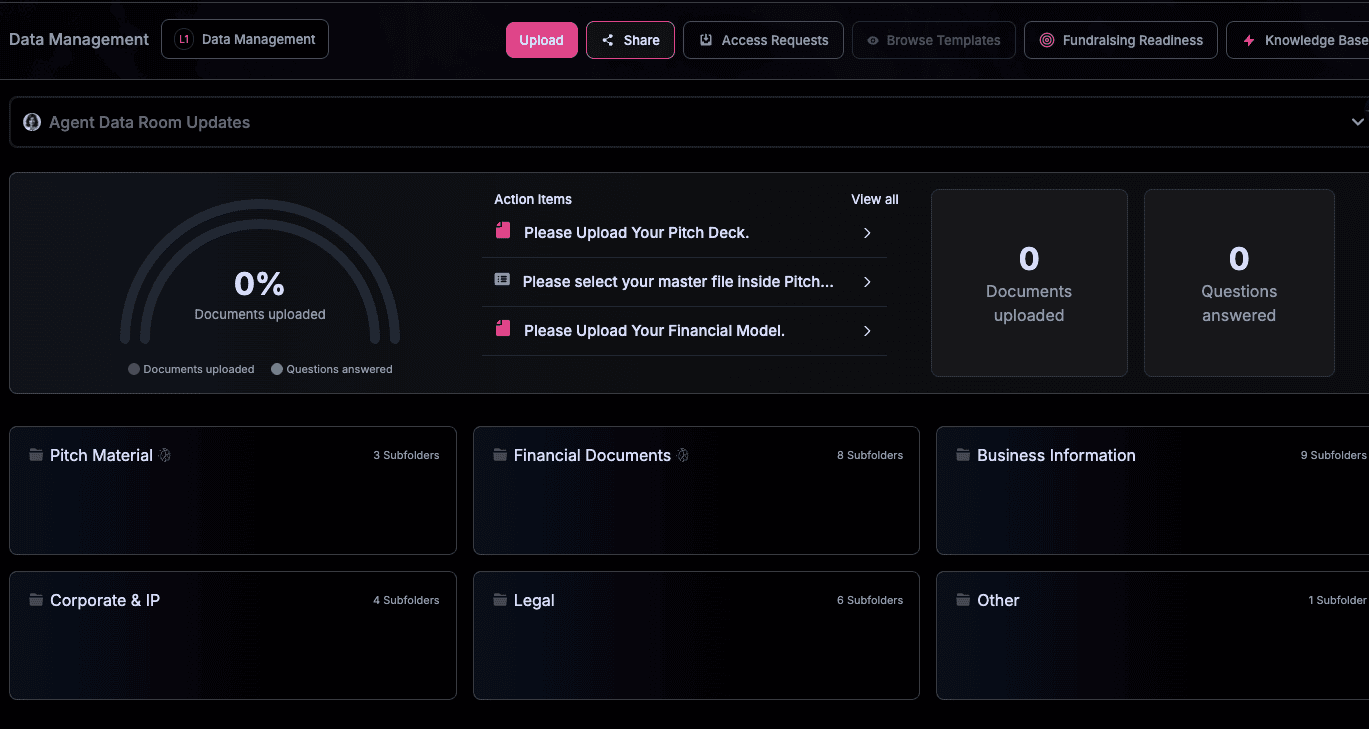
For investors, askRIA does something no other platform on this list does. When an investor accesses a data room on askRIA, the platform automatically extracts diligence questions from every document, scores the answers, and presents a deal evaluation. Red flags, Green flags, a score against the investor's own criteria and missing information flagged with the ability to request it directly.
This is what diligence infrastructure means.
A system that does the mechanical evaluation work so humans can focus on the judgement calls: the founder's credibility, the market timing, the conviction.
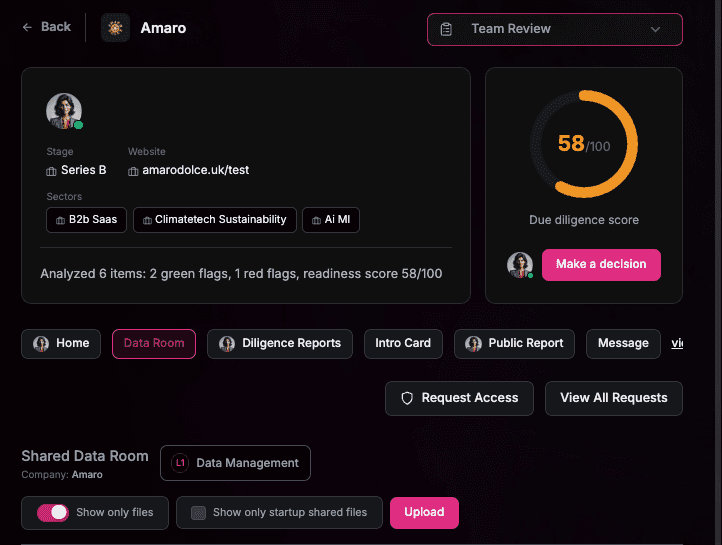
This matters whether the fund is a solo angel writing a £25K cheque or a PE firm running diligence across 50 deals.
The underlying infrastructure is the same. For institutions that need it, askRIA also builds custom diligence and decision infrastructure deployed in their own environment on their preferred LLM. The data stays on their infrastructure. Contact hello@askria.ai for enterprise pricing.
Frequently asked questions
What is a startup data room? A startup data room (also called a virtual data room or VDR) is a secure online repository where founders organise and share confidential business documents with investors during fundraising. Unlike Google Drive or Dropbox, a proper data room includes structured folders, engagement tracking for founders, and evaluation tools for investors. Modern platforms like askRIA add automated gap detection, investor readiness scoring, and AI-powered deal evaluation.
What are the best startup data room alternatives to Google Drive? The main alternatives are DocSend (good for pitch deck tracking, $10-$180/month), Dropbox (file storage only), enterprise VDRs like Ansarada ($15,000+/year, built for large M&A), and purpose-built platforms like askRIA (£49/month for founders, £20/month for investors). The key difference is what happens after files are uploaded. DocSend tracks views. askRIA automatically structures the data room, scores investor readiness, detects red flags, and provides investors with automated deal evaluation.
Why is Google Drive bad for fundraising? Google Drive lacks every feature that founders and investors need during diligence. Founders can't track which investors are reviewing their documents. Investors receive an unstructured folder of files with no way to evaluate the deal efficiently. There's no gap detection, no readiness scoring, no structured communication, and no automated evaluation. According to Gartner (2025), 75% of VC deal reviews are now AI-informed, and Google Drive data rooms can't be parsed by AI diligence tools effectively.
What does askRIA do that DocSend doesn't? DocSend tracks who viewed documents and how long they spent on each page. That's useful for founders. But it doesn't help investors evaluate the deal. askRIA does both: it gives founders engagement tracking, gap detection, and a readiness score, while simultaneously giving investors automated question extraction, deal scoring against custom criteria, and red/green flag analysis. DocSend is a sharing tool. askRIA is diligence infrastructure.
Can PE firms and family offices use askRIA? Yes. askRIA's infrastructure works from seed to enterprise. For private equity firms, family offices, and M&A funds, askRIA provides automated document processing, deal benchmarking, red flag detection, IC memo generation, and portfolio monitoring. For institutions requiring full data control, askRIA builds custom diligence agents deployed on their own infrastructure using their preferred LLM. Contact hello@askria.ai for enterprise pricing.
Do investors actually care about how the data room is structured? Yes. Every experienced investor we've spoken to says the same thing: a messy data room raises questions about how the founder runs their company. At seed stage, investors are reviewing 50+ deals per month. A well-structured data room with clear folders and complete documentation makes evaluation faster. A Google Drive link with 30 unorganised files gets closed. The format of the data room has become a filter, not just a formality.
A good data room helps founders prepare and helps investors evaluate. Both sides benefit when the infrastructure is built for diligence, not just file sharing. See what an askRIA data room looks like for founders and investors. Email hello@askria.ai for a demo.