How Much Due Diligence Should Angel Investors Do?
A partner at a mid-size VC told us something last year that stuck. "We spend 80 hours on diligence before writing a cheque." Angels spend roughly 80 minutes.
The Angel Capital Association recommends a minimum of 40 hours of angel investor due diligence per deal. The Wiltbank study on angel returns, covering 1,137 exits across the US and UK, found that investments with more than 20 hours of diligence were 5x more likely to produce positive returns.
Solo angels writing $25K to $75K cheques don't have 40 hours. They have a day job, a family, and whatever scraps of time they can find between calls. So they default to gut feel. Read the deck, take the meeting, check the vibe, and wire the money.
Then they find out 18 months later that the revenue was overstated. The runway was 4 months, not 12.
The answer isn't "spend more time." It's to stop doing the mechanical work.
The Hidden Cost of Startup Due Diligence
Most angels don't think about diligence as a cost. But it is.
A junior analyst at a fund costs roughly $55K-$65K. That analyst screens 250+ deals per year and invests in 8 deals. The maths works out to roughly $1,000 per deal just for the screening, and $8,000-$12,000 per invested deal. That's the professional cost of diligence with a person doing the mechanical work full-time.
Solo angels are doing the same work. They're just not paying for an analyst. They're paying with their own time, which is usually worth more.
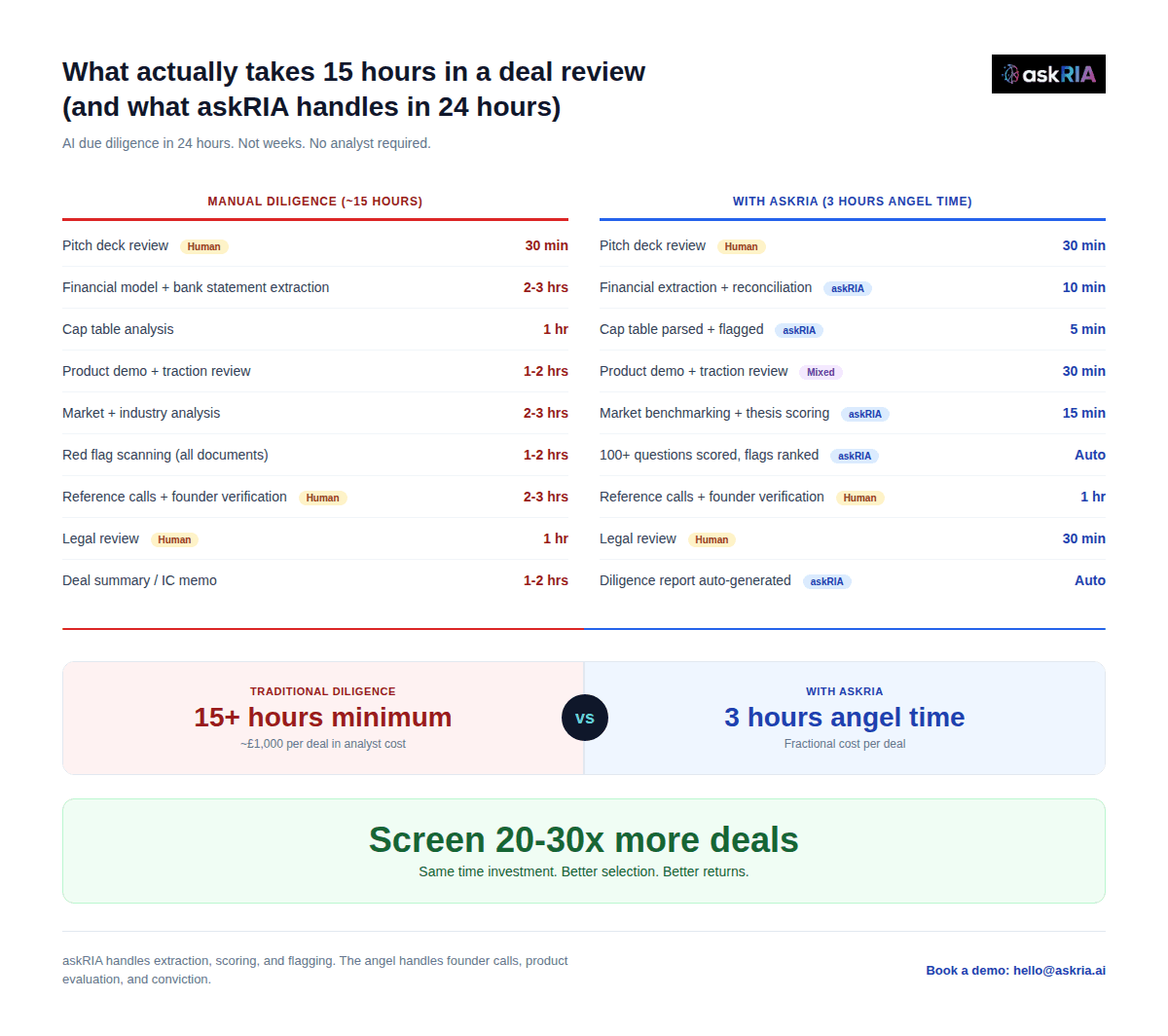
An angel reviewing a deal manually spends roughly 12-15 hours per deal across pitch deck review, financial model extraction, cap table analysis, competitive research, market sizing, product demo evaluation, reference calls, and legal review. At 4-5 deals a month, that's 50-75 hours, per month, making it a second job.
8-10 of those hours are mechanical. Pulling numbers out of PDFs. Cross-referencing the financial model against bank statements. Scanning legal documents for unusual terms. Building a deal summary from scratch. This is work that doesn't require human judgement. It requires a system.
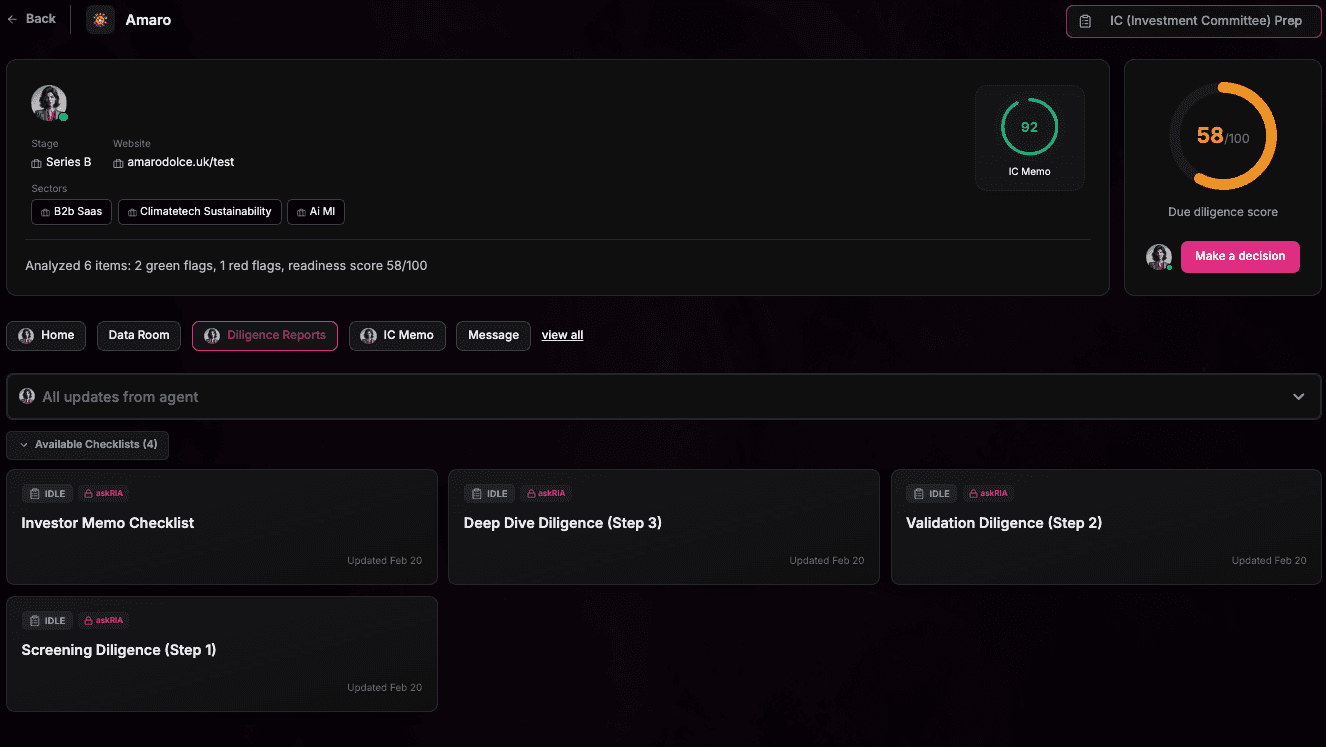
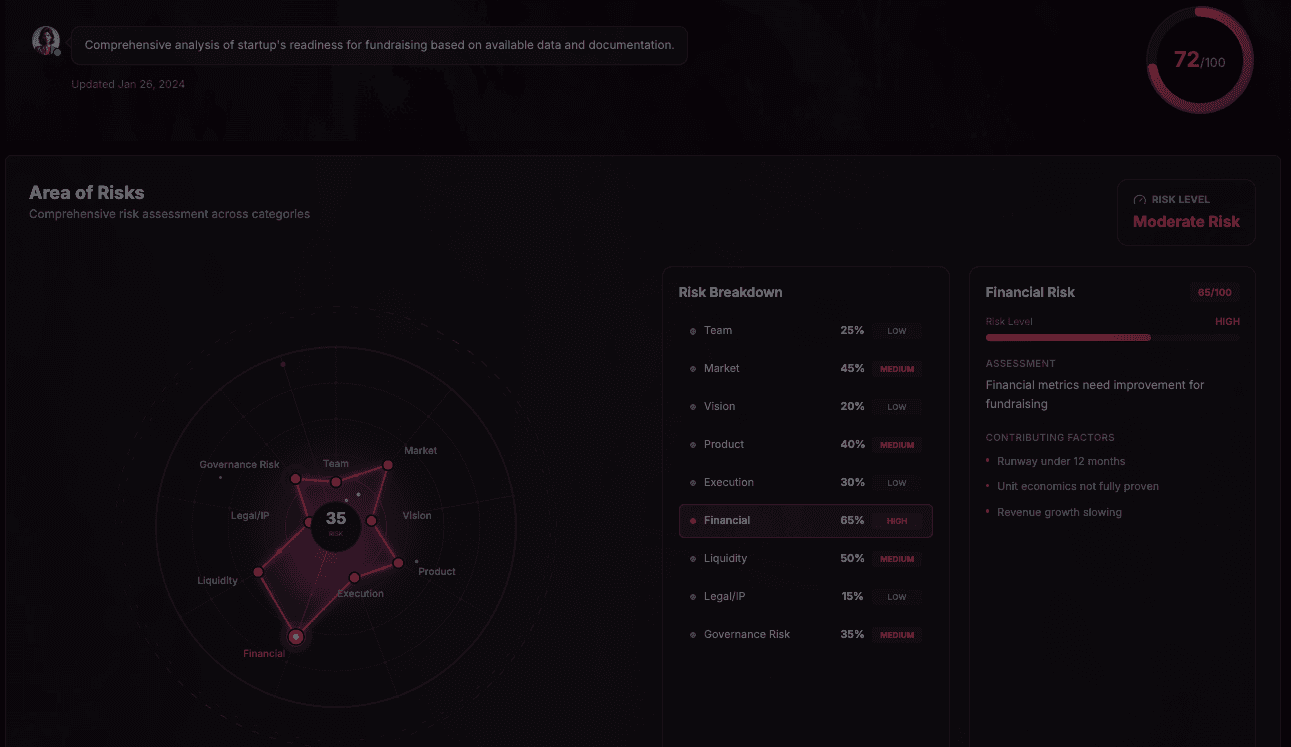
askRIA is designed to handle this journey using a different approach. With askRIA, the grunt work behind DD happens in under 24 hours. The system processes the documents, extracts the questions, scores the answers, flags the risks, and produces a structured diligence report. The angel shows up to a finished analysis, not a Dropbox folder.
The cost comparison:
Manual diligence (analyst or self): ~$1,000 per deal for an analyst or 12-15 hours of Angel investor time
With askRIA: Fractional cost per deal. The same output that an analyst takes days to produce, is delivered in hours.
How askRIA Compresses Due Diligence into 24 Hours
askRIA compresses weeks of analyst work into 24 hours. When a founder shares their data room on askRIA:
100+ diligence questions are extracted automatically from the documents
Each answer scored against personalised investment criteria
Red flags and green flags are identified and ranked by severity
Missing documents are flagged
Deals are benchmarked against custom thesis
Structured diligence report is generated
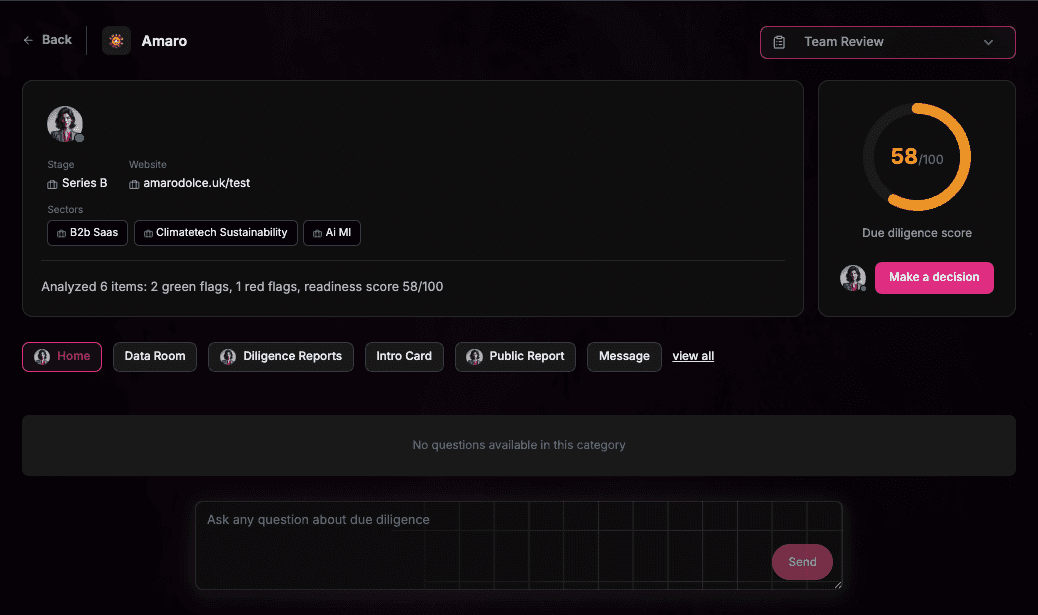
An investor can simply open the workspace, read the scores, check the flags and spend the remaining 5-6 hours on the human aspect of diligence: talking to the founder, evaluating the team, calling references, and forming conviction.
Three things matter for angels:
Capital protection. Solo angels writing $25K-$100K can't afford to miss the red flag buried on page 47 of a financial model. askRIA's diligence agent reads every page, extracts every question, scores every answer automatically. It doesn't get tired at 11pm. It doesn't skip the cap table because the deck looked good.
More deals, better selection. When diligence takes 12 hours per deal, most solo angels can evaluate maybe 2-3 opportunities a month before burning out. Cut that to 5-7 hours, and the same angel reviews 4-5 deals. More deal flow means better selection. Better selection means better returns.
Faster access to better opportunities. Founders who use structured data rooms (including askRIA's founder workspace) tend to be more organised and more diligence-ready. When both sides of a deal are on askRIA, the founder's agent and the investor's agent communicate directly. Missing documents get requested. Follow-up questions get answered. Information gaps close in days, not weeks of email chains.
For angels writing cheques between $25K and $100K, the move is straightforward. Rent the diligence infrastructure. Focus on the human calls that actually determine outcomes. Let the system handle what an analyst would do if you had one.
For PE firms, family offices, and fund managers
The same infrastructure scales. Whether the fund is evaluating one deal or fifty, the mechanical diligence work is identical. The difference is volume.
We build custom diligence agents for institutions that want askRIA deployed in their own environment, on their preferred LLM, with their data staying on their infrastructure. Scoring criteria, benchmarking parameters, red flag definitions: all customised to their thesis.
Contact hello@askria.ai for enterprise pricing.
Frequently asked questions
What is angel investor due diligence? Angel investor due diligence is the process of verifying a startup's financials, market position, team background, and legal structure before investing. It covers revenue reconciliation, cap table review, competitive analysis, founder reference checks, and legal document review. The Angel Capital Association recommends 40 hours per deal. With a structured framework and diligence infrastructure like askRIA's investor workspace, the mechanical portion compresses to under an hour, while the 4-5 hours of human judgement work stays the same.
How many hours of due diligence should an angel investor spend per deal? The Wiltbank studies found that 20+ hours of diligence made angel investments 5x more likely to return positively. Under 20 hours, 60% returned less than 1x. A structured 3-day framework covers the critical checks in 10-13 hours manually, or 5-7 hours with infrastructure handling financial extraction, scoring, and red flag detection.
What is the most common mistake in the angel investing due diligence process? Skipping financial verification. Most solo angels trust the founder's stated numbers because double-checking feels adversarial. But revenue discrepancies, overstated runway, and messy cap tables are the three most common issues at seed stage. They're also the easiest to catch, especially with automated extraction that flags mismatches before you've opened a spreadsheet.
How do you evaluate a startup as an angel investor with no finance background? Focus on consistency, not complexity. Does the revenue in the model match the bank statements? Does the stated runway match the cash divided by burn rate? Can the founder explain the cap table in 60 seconds? These checks don't require a finance degree. They require willingness to ask the uncomfortable question. askRIA's investor workspace handles the extraction and scoring automatically, so angels without financial modelling skills can see the red flags.
What should angels look for in a startup cap table? Clean structure. Founders should own enough equity to stay motivated, usually 60-80% at seed. The option pool should be large enough to attract key hires but not so large it dilutes everyone. Check for unconverted SAFEs, multiple share classes, and side agreements. askRIA parses cap tables automatically, flagging dilution risk, unusual instruments, and founder equity levels.
Can larger funds use the same diligence framework? Yes. The 3-day structure (financials, market, team/legal) applies at any scale. For PE firms, family offices, and M&A funds, the mechanical work is better handled by diligence infrastructure than by analysts. askRIA builds investor workspaces and custom diligence agents for institutions running this process across multiple deals.
Should solo angels join a syndicate instead of investing alone? Syndicates reduce the diligence burden by distributing it across members. Angel groups historically produce better returns partly because of more thorough diligence. But syndicates aren't accessible to everyone, and their fee structures (typically 20% carry) reduce your upside. For solo angels who prefer independence, a structured angel investor checklist combined with askRIA's investor workspace gives the same infrastructure advantage without the carry.
Due diligence shouldn't depend on how much free time investors have. We built askRIA's investor workspace for angels who take their own capital seriously. Automatic document extraction, 100+ diligence questions scored in minutes, Red flag detection, Deal benchmarking against custom thesis.. Book a free demo at Calendly link or email hello@askria.ai. We're giving early access to the first 50 angels who sign up.