due-diligence
Fundraising
Data Room
askRIA vs Carta: Ownership Tools vs Diligence Truth

Adhrita Nowrin
Feb 10, 2026
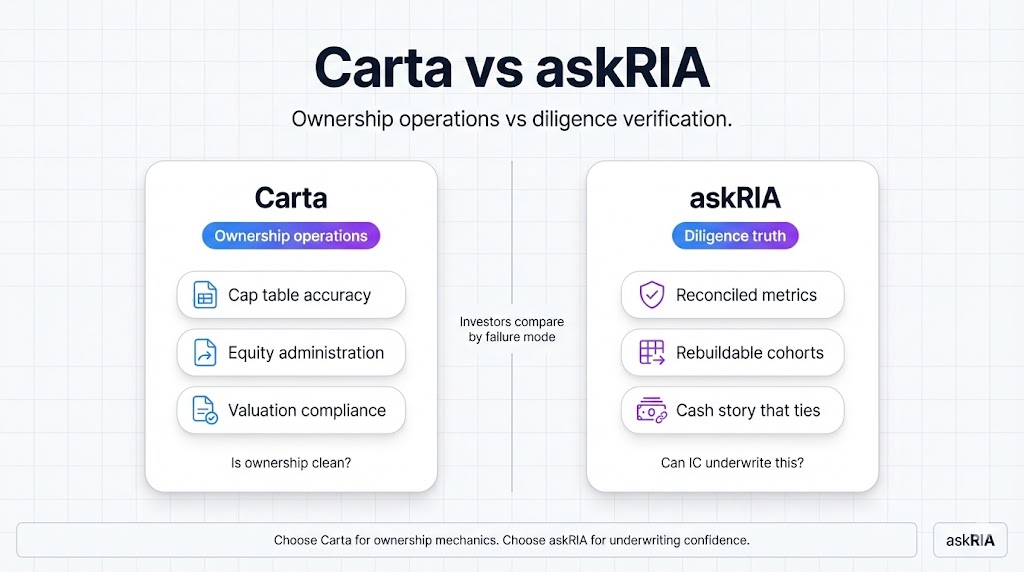
You are evaluating Carta and askRIA and want to understand which one reduces fundraising drag: ownership operations or diligence verification.
Choose Carta when the problem is ownership operations: cap table accuracy, equity administration, and valuation compliance. Choose askRIA when the problem is diligence truth: metrics that reconcile across files, cohorts that can be rebuilt, and a cash story investors can take into IC without re-asking the same questions.
The decision investors actually care about
Most founders compare tools by features. Investors compare by failure mode.
Ria frames the decision like this:
Are you blocked by ownership mechanics, or by underwriting confidence?
Ownership mechanics are table stakes. Underwriting confidence is what moves a deal into IC.
What Carta is built to do
Carta is primarily an equity and ownership system. The core use cases are cap table management, equity plan administration, and valuations such as 409A.
Carta also publishes guidance and products around fundraising operations like data rooms and investor relations workflows. That is still in the lane of organising and distributing information, plus maintaining ownership context.
Use Carta when you need:
A clean, auditable cap table and equity history
Option grants, vesting, exercises, and equity plan administration
Valuation support for option pricing and compliance workflows
What askRIA is built to do
Ria is not trying to be your cap table system.
Ria is the associate partners trust with the model. She reconciles the evidence before the narrative. askRIA’s core promise is speed plus verification: return a diligence pack in 48 hours, including a gap report, evidence links, and a brief.
Use askRIA when you need:
Numbers that reconcile across deck, model, dashboard, and data room
Cohorts that tie to source data and do not drift between exports
A cash story investors can test quickly without reopening basic questions
Where founders get this wrong
Founders often treat diligence like document sharing.
Investors treat diligence like verification.
A clean data room folder does not fix:
Metric drift across artefacts
Cohort tables that cannot be rebuilt
Burn and runway that do not reconcile to bank movement
Carta can keep ownership correct. It does not make your operating metrics consistent by default.
That is a different job.
What breaks in diligence
Ria sees the same three repeat triggers across most raises.
1) Metric drift
Same KPI, different definition. Deck says one thing, model says another, dashboard says a third.
Investors do not “get confused”. They stop trusting the chain of evidence.
2) Weak cohort integrity
Cohort date shifts. Expansion is mixed into retention. Reactivations are counted inconsistently. The cohort cannot be rebuilt from a raw export.
Underwriting stops here because the retention mechanism is unclear.
3) Cash story that does not reconcile
Runway and burn become un-usable when cash does not tie across the model’s statements and actual movements. The investor cannot defend the number in IC.
What Ria checks
Ria runs checks that reduce repeat questions. They are mechanical. They are fast.
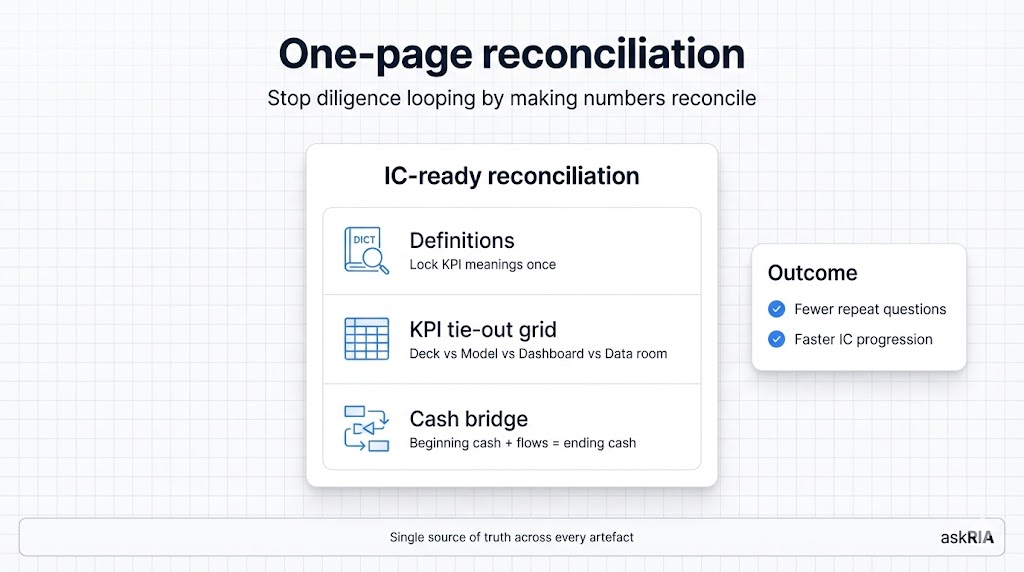
Step 1: Lock metric definitions
Ria writes a one-page metric dictionary:
Name
Formula
Denominator
Time window
Source of truth
Owner
Then she ties every reported KPI back to it.
Step 2: Build a tie-out grid across artefacts
Rows: the 10 to 12 KPIs investors cite most.
Columns: deck, model, dashboard, data room files, investor update.
Any mismatch becomes a logged variance, with a reason.
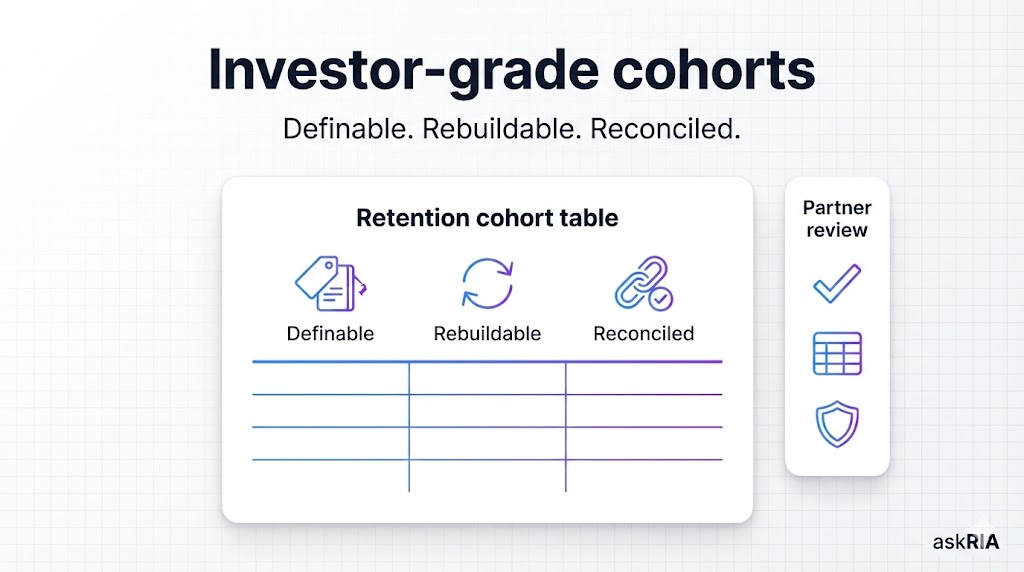
Step 3: Rebuild cohorts from raw
Ria rebuilds the cohort table using the declared cohort date and raw exports. If it cannot be rebuilt, it is not diligence-grade.
Step 4: Reconcile burn to cash movement
Ria checks:
Beginning cash + net cash flow = ending cash
Financing events flow correctly
Working capital assumptions are explicit
If this fails, runway is not defendable.
How to choose in 60 seconds
Choose Carta if:
Your cap table is messy, incomplete, or not audit-ready
You need equity administration and valuation workflows to run cleanly
Choose askRIA if:
Investors keep looping on the same questions
Your numbers drift across files
Cohorts and cash logic do not hold under review
Many companies use both, because ownership and diligence are separate systems with separate failure modes.
What changes in outcomes
When the diligence loop stops, investor questions change.
You get fewer “send the raw” requests and fewer resets. The conversation moves to underwriting risk and deployment plans.
That is what progress looks like in a raise.
Practical checklist
Use this before you send anything to an investor.
Ownership readiness (Carta lane)
Cap table matches issued instruments and board approvals
Option plan, grants, and vesting schedules are current
Valuation approach is documented for option pricing workflows
Diligence truth (Ria lane)
The top KPIs match across deck, model, and dashboard
Every KPI has a locked definition and owner
Cohorts can be rebuilt from raw exports
Burn and runway reconcile to cash movement
One IC-ready folder exists with one version of truth
If investors are looping on questions, Ria will show you exactly why. Run your materials by Ria before you send the deck.
FAQs
Is Carta a diligence tool?
Carta is primarily an equity and ownership platform. It is designed around cap table, equity administration, and related workflows like valuations, with additional products and guidance around fundraising operations.
Does Carta fix metric drift across my deck and model?
No. Metric drift is an operating metrics and reconciliation problem. Ownership software does not automatically reconcile your revenue definitions, cohorts, and cash story.
Do I need askRIA if my cap table is already clean?
If your raise is stalling due to repeat diligence questions, yes. Cap table correctness does not resolve underwriting uncertainty in cohorts, payback, or runway.
Can I use askRIA without changing my ownership system?
Yes. askRIA is not replacing cap table management. It focuses on diligence readiness and evidence coherence.
What is the fastest signal I picked the wrong tool?
If your cap table is fine but investors keep re-asking basic questions, you have a diligence truth problem, not an ownership workflow problem.