Fundraising
due-diligence
investor-tips
Data Room
askRIA vs Visible: Running a Fundraise vs Earning Underwriting Trust

Adhrita Nowrin
Feb 17, 2026
You are evaluating Visible and askRIA and want to understand which one reduces fundraising drag: running the process, or making the numbers defensible in underwriting.
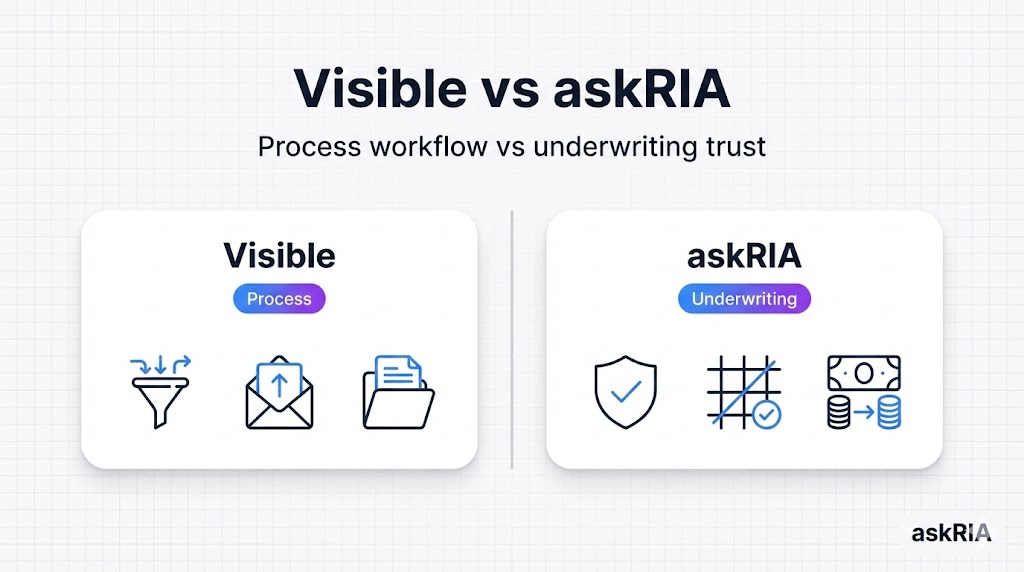
Visible helps founders run the fundraising process: investor pipelines, updates, deck sharing, and data rooms. askRIA helps founders and investors earn underwriting trust by reconciling metrics, rebuilding cohorts from source data, and tying runway to real cash movement so investment committees can move without resetting.
Problem statement framed as investor reality
When a fundraise slows down, founders assume the process is broken.
Investors slow down when the numbers are.
A clean pipeline does not stop a partner from asking the same question twice. It only shows the question arrived.
Ria treats this as a failure mode: the investor cannot reuse your answer internally.
What Visible is built to do
Visible positions itself as a fundraising workflow and investor relationship platform.
It focuses on operational execution:
Investor CRM and fundraising pipelines
Investor updates and reporting templates
Deck sharing and data room organisation
Dashboard visibility
If your bottleneck is process discipline, cadence, and distribution, this category of tool is useful.
It keeps the raise organised.
It does not make the numbers defensible by default.
What Ria is built to do
She assumes investors will pressure-test your numbers and builds your materials to survive that pressure.
Where most tools optimise for visibility, Ria optimises for verification
She:
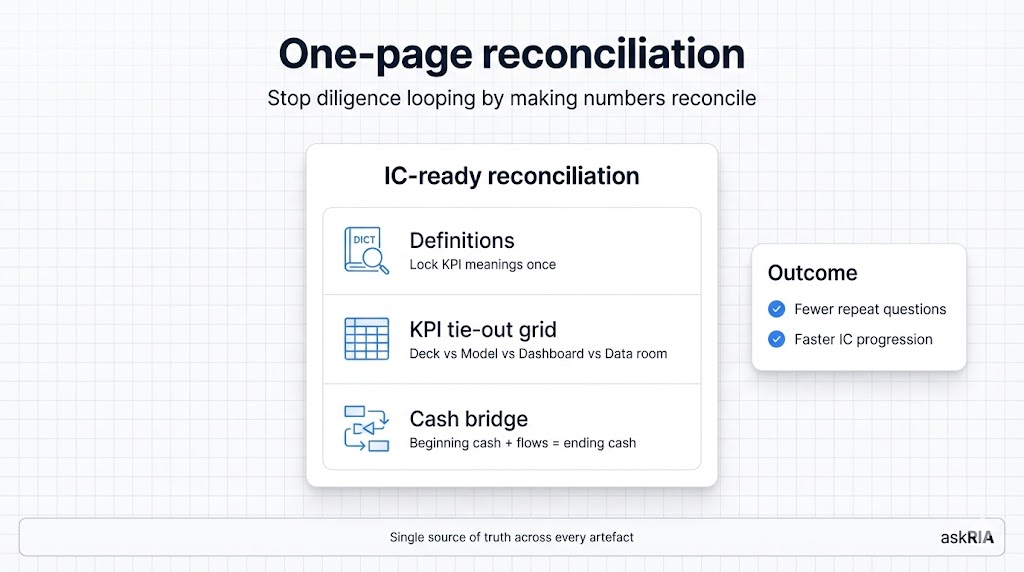
Locks KPI definitions across deck, model, dashboard, and updates
Builds a reconciliation grid so numbers stop drifting
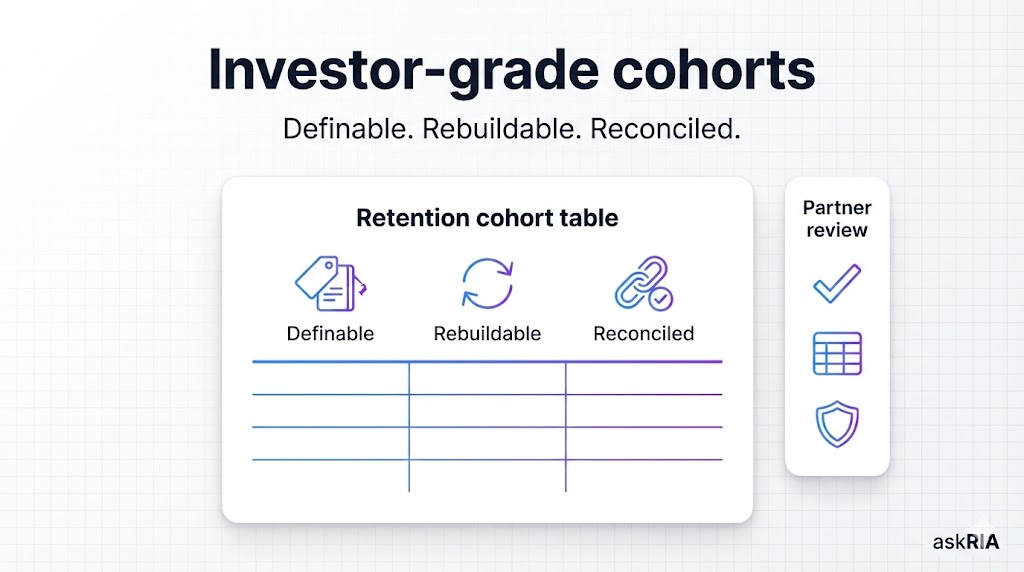
Rebuilds cohort tables from raw exports
Ties burn and runway to real cash movement
Flags the two breakpoints that would stall an IC discussion
The decision investors actually care about
This decision is not “which tool has more features”.
It is: Are you failing because you cannot run the process, or because investors cannot underwrite the truth?
Visible improves process execution
Pipelines, updates, dashboards, data room. The fundraise runs.
Ria improves underwriting confidence
Definitions lock. KPI tie-out. Cohort rebuild. Cash reconciliation. The deal stops resetting.
What breaks in diligence
When investors loop, it is usually one of these:
1) Metric drift
Same KPI, different definition. Deck vs model vs dashboard disagree. The investor cannot cite the number in an IC memo because it is not stable.
2) Weak cohort integrity
Cohorts look fine until someone asks to rebuild them. Anchor date is unclear, expansion is blended into retention, reactivations are handled inconsistently. Underwriting pauses.
3) Cash story that does not reconcile
Runway claims do not tie to bank movement and statement logic. Investors stop trusting timing.
Visible can help you share the artefacts cleanly. It does not make the artefacts reconcile by default.
What Ria checks
Ria runs the checks that stop repeat questions.
Step 1: Lock definitions
Ria creates a one-page metric dictionary for the KPIs investors repeat:
formula
denominator discipline
time window
inclusions and exclusions
source export
owner
Step 2: Build the KPI tie-out grid
Rows: 10 to 12 headline KPIs.
Columns: deck, model, dashboard, data room, last update.
Any mismatch becomes a logged variance with a reason and a source link.
Step 3: Rebuild cohorts from source
Ria rebuilds the cohort table from raw exports using the declared anchor event. If it cannot be rebuilt, it does not ship.
Step 4: Reconcile cash
Ria ties beginning cash and net cash movement to ending cash. If this fails, runway is not defendable.
How to choose in 60 seconds
Choose Visible if:
You need investor pipeline tracking
Your updates lack structure
You need clean distribution and dashboards
Your numbers are already internally consistent
Choose askRIA if:
Investors keep re-asking the same questions
Metrics drift across artefacts
Cohorts cannot be rebuilt
Cash and runway do not tie out
Partner meetings stall after diligence
A common stack that uses both:
Visible for workflow and investor communication
askRIA for reconciliation, diligence truth, and IC-ready materials
Process plus proof.
What changes in outcomes
When underwriting trust is earned, the questions change.
You stop getting:
“Which number is correct?”
“Can you send the raw?”
“Why did this change?”
You start getting:
“What is the real risk?”
“What would you do with another 12 months of runway?”
“Who leads the round?”
That is the shift from activity to conviction.
Practical checklist
Use this before you send the deck or open the data room.
Fundraise workflow (process)
investor list and pipeline are current
update cadence is set and consistent
data room structure is stable and permissioned
Underwriting trust (evidence)
top KPIs match across deck, model, dashboard, and update
each KPI has a single definition and owner
cohort tables can be rebuilt from source exports
cash and runway tie to cash movement
If investors are looping on questions, Ria will show you exactly where the story breaks. Run your materials by Ria before you send the deck.
FAQs
Is Visible a fundraising CRM?
Yes. It supports investor pipelines, updates, deck sharing, and reporting workflows.
Does Visible help with investor updates and dashboards?
Yes. Visible offers investor updates, templates, and dashboards for sharing metrics.
Does Visible fix metric drift across my deck and model?
Not by default. It helps distribute and present data. The reconciliation work is separate.
When should I prioritise askRIA over a fundraising workflow tool?
When your bottleneck is underwriting trust: repeated questions, inconsistent KPIs, cohorts that cannot be rebuilt, or a cash story that does not tie out.
Can teams use both?
Yes. A common setup is Visible for cadence and distribution, and Ria for diligence truth and IC-ready evidence.
Does Visible reconcile my financial model and deck automatically?
No. It distributes and presents materials. Reconciliation work is separate.
What does askRIA do differently?
askRIA locks KPI definitions, builds a reconciliation grid, rebuilds cohorts from source data, and ties runway to real cash movement so investors can underwrite confidently.
When should I prioritise askRIA?
When your raise is stalling during diligence, not during outreach.