due-diligence
Fundraising
startup-metrics
Financial Model
The One-Page Reconciliation That Saves You Weeks

Adhrita Nowrin
Feb 13, 2026
You want a fast, investor-grade way to stop diligence looping by reconciling the numbers across your materials.
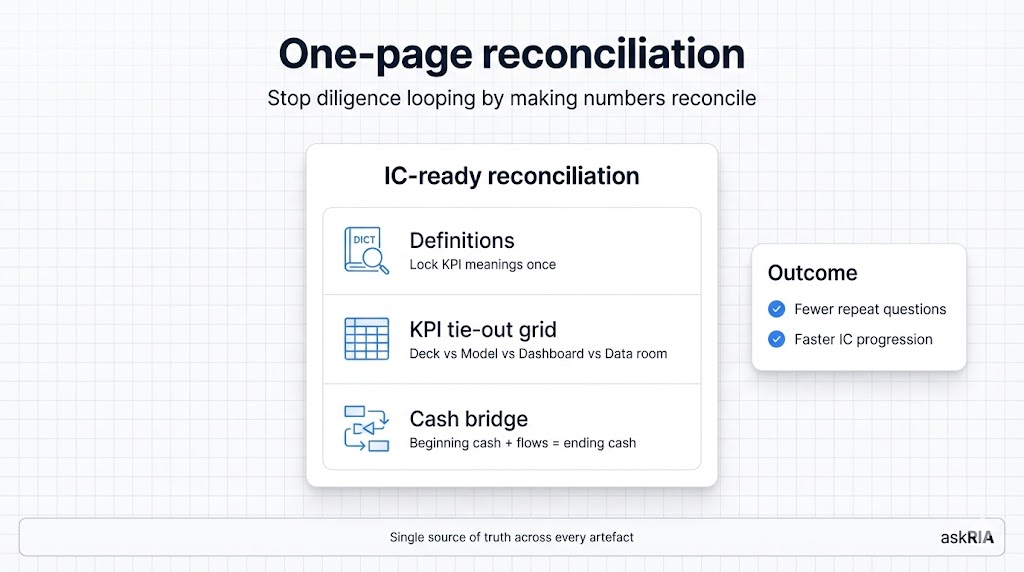
Investors keep looping when the same KPI changes across the deck, model, dashboard, and data room, or when cash and runway do not tie out. The one-page reconciliation fixes this by forcing a single definition set, a single KPI tie-out grid, and a simple cash bridge that an analyst can defend in an IC memo.
Problem statement framed as investor reality
“Come back later” is usually not about timing. It is an underwriting pause.
If the numbers do not reconcile, the investor cannot reuse your answers internally. They re-ask. They restart. Your deal slips.
Ria treats reconciliation as the first gate. Narrative comes after the numbers hold.
What breaks in diligence
Ria sees three failure modes behind most repeated questions.
1) Metric drift
The KPI exists in multiple places with different definitions, time windows, or inclusion rules. That turns one business into multiple truths.
2) Cohort integrity failures
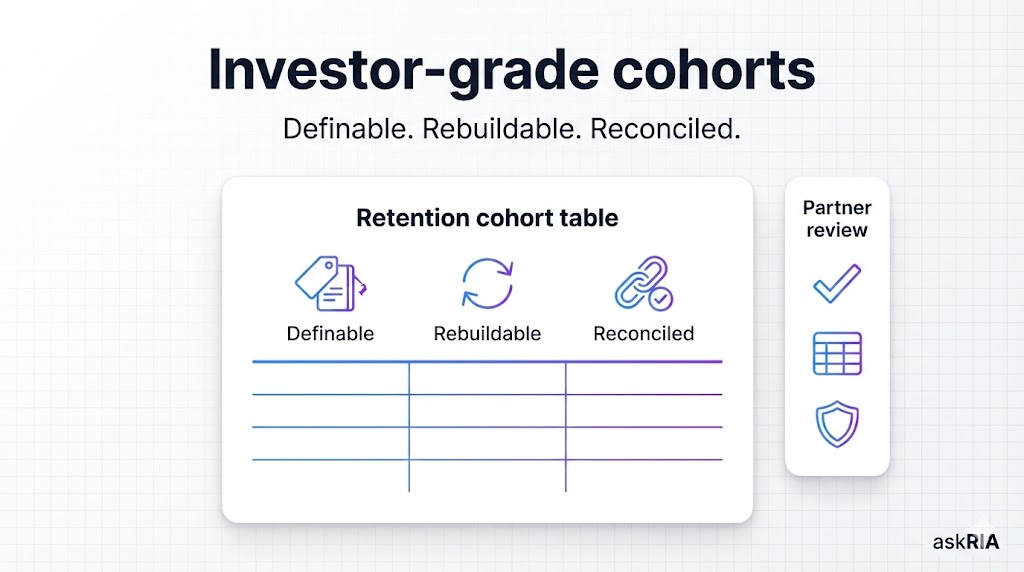
Cohorts are presented, but they cannot be rebuilt from source exports. Dates shift. Expansion is blended into retention. Investors stop trusting the mechanism.
3) Cash story that does not tie out
Runway, burn, and funding timing become unusable when cash does not reconcile through the statements. If cash does not balance, the model is decorative.
The one-page reconciliation
This is the page Ria builds before any diligence call. One page. No slides. No commentary.
It has three blocks.
Block 1: Metric definitions
Ria writes a short metric dictionary for the KPIs that show up in the deck.
For each KPI, Ria locks:
Name
Formula
Time window
Inclusion and exclusion rules
Source table or export
Owner
If the definition is not locked, the number is not real.
Block 2: KPI tie-out grid
Ria creates a grid to catch drift fast.
Rows: 10 to 12 headline KPIs (ARR or revenue, gross margin, burn, runway, CAC, payback, retention, NRR, active customers, ARPA).
Columns: Deck, model, dashboard, data room file, investor update.
Each cell is one number for one period. Every mismatch gets a reason and a source link. “Different cut” is not a reason. The reason must be mechanical.
This is also how you stop sending investors conflicting versions. (
Block 3: Cash bridge
Ria adds a simple bridge that ties what you say about runway to the statement logic.
Minimum fields:
Beginning cash
Cash from operations
Cash from investing
Cash from financing
Ending cash
Then Ria checks statement links. Net income feeds into cash flow. Cash flow changes cash on the balance sheet. Retained earnings updates through net income.
The exact checks Ria runs
Ria runs these in order. It is a checklist, not a brainstorm.
Definition lock
Ria confirms every KPI has one definition and one owner.
Top-line tie-out
Ria forces deck revenue and ARR to match model outputs for the same cut and period. If they differ, Ria documents the cut and replaces the deck number.
Cohort rebuild test
Ria rebuilds the cohort table from raw exports using the declared cohort date. If it cannot be rebuilt, it does not ship.
Cash reconciliation
Ria ties cash movement through operating, investing, and financing activities to ending cash. If ending cash does not match, runway claims are paused.
Single-source packaging
Ria ships one IC-ready folder with one set of numbers. Version sprawl creates diligence loops.
How to fix it
If you are already in a raise and the loop started, do this over 48 hours.
Pick 10 to 12 KPIs investors keep citing.
Lock definitions in one page.
Build the tie-out grid and resolve mismatches.
Rebuild cohorts from source exports.
Make cash balance and ensure statement links hold.
What changes in outcomes
When the one-page reconciliation exists, questions stop repeating.
Investors move from verification questions to underwriting questions. That is the shift you want. It is calm. It is measurable. It shows up as fewer follow-ups and faster internal progression.
Practical template
Copy and paste this into a doc. Keep it to one page.
Section 1: Definitions (KPI dictionary)
KPI | Formula | Window | Inclusions | Exclusions | Source | Owner
Section 2: Tie-out grid
KPI | Period | Deck | Model | Dashboard | Data room | Notes | Source link
Section 3: Cash bridge
Beginning cash | CFO | CFI | CFF | Ending cash
Check: Ending cash equals balance sheet cash
If investors are looping on the same questions, Ria will show you exactly where the numbers drift and which table breaks cash. Run your materials by Ria before you send the deck.
FAQs
What is reconciliation in fundraising diligence?
It is proving that the same KPI matches across deck, model, dashboard, and data room, with definitions locked and sources traceable.
How many KPIs should be in the one-page reconciliation?
Usually 10 to 12. If you add more, you lose speed and the page stops working.
What is the fastest way to spot metric drift?
A tie-out grid across the artefacts investors actually read, with one period and one cut.
Why does cash reconciliation matter so much?
Because cash is the reality check. If cash does not tie through the statements, runway and burn cannot be defended.
Can I do this without rebuilding my whole model?
Yes. The goal is to stabilise definitions and outputs. Rebuild only the broken sections, especially cohorts and cash.