due-diligence
Fundraising
startup-metrics
Cohorts That Survive Partner Review

Adhrita Nowrin
Feb 19, 2026
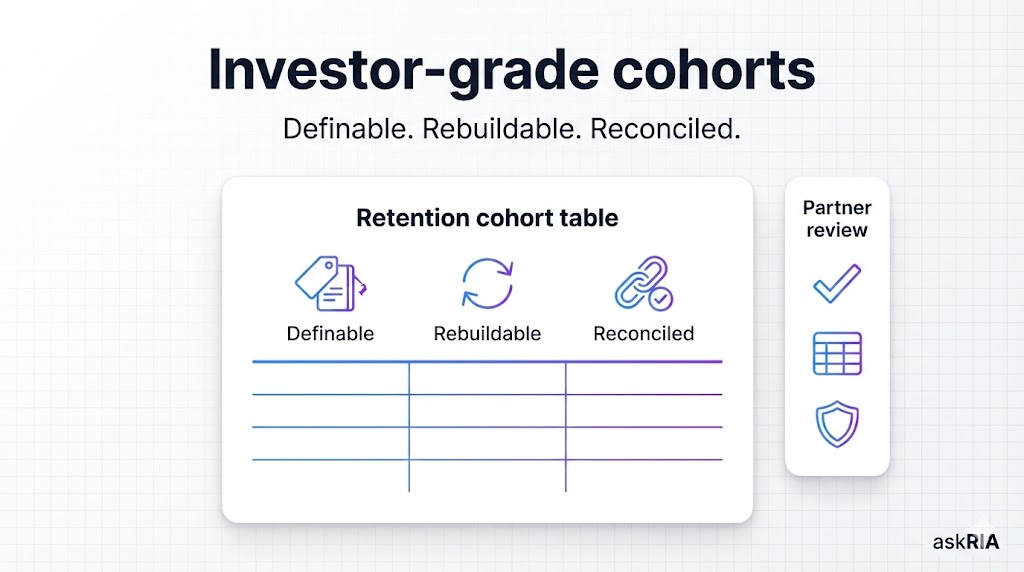
You need investor grade retention cohorts that hold up under partner review, meaning they are definable, rebuildable from source data, and consistent with revenue and cash.
Investor-grade cohorts survive partner review when the anchor event is clearly defined, the cohort table can be rebuilt from raw data, retention is separated from expansion, and cohort totals reconcile to recognised revenue. Cohorts fail not because retention is weak, but because the mechanism cannot be verified.
Problem statement framed as investor reality
Partners do not reject cohorts because the curve looks bad.
They reject cohorts because they cannot underwrite the logic behind the curve.
In partner review, the question is simple:
Can this analysis be trusted enough to reuse inside an investment memo?
If the answer is unclear, diligence pauses, regardless of how strong the retention appears.
A cohort that cannot be rebuilt is not analysis.
It is presentation.
What breaks in partner review
Across early and growth-stage raises, cohort charts usually fail for three structural reasons.
1) The anchor event is not defined
“Month 0” means nothing unless explicitly defined.
Common anchors include:
Signup
Activation
First payment
First invoice
Each produces a different retention story.
If the anchor is not stated, investors cannot interpret behaviour, only shape.
Subscription businesses typically anchor on first payment or first invoice, because it aligns cohorts with revenue reality rather than trial noise.
2) The table cannot be rebuilt from source
A screenshot is not diligence-grade evidence.
Partners expect:
the cohort table behind the chart
traceability to billing or product exports
reproducible logic
If rebuilding the cohort requires manual editing, underwriting stops.
Cohort analysis exists to isolate behaviour over time, not to summarise averages.
3) Retention is blended with expansion
One of the most common diligence failures:
Retention and expansion blended into one curve.
The chart looks strong while customers quietly leave.
Partners need to see the mechanism clearly:
Who stayed
Who churned
Who expanded
Who contracted
Without separation, retention cannot be trusted.
What Ria checks
Ria does not start with the curve. Ria starts with the table and the definitions.
Step 1: Lock the cohort definition
Ria writes the cohort spec in plain terms:
Cohort unit: logo, account, workspace, seat, or user
Anchor event: signup, activation, first payment, first invoice
Time grain: weekly or monthly, and why
Inclusion rules: who counts as “in” at month 0
Exclusion rules: internal accounts, refunds, chargebacks, test data
Measurement: logo retention, revenue retention, usage retention, or all three
Ria chooses anchors based on what the business sells. Subscription businesses often anchor on first payment or first invoice because it reduces noise from long trials and aligns cohorts to real revenue behaviour.
Step 2: Rebuild the cohort table from raw exports
Ria rebuilds the table from source data before showing it to anyone.
Minimum inputs:
A customer identifier that is stable over time
An anchor date column
A monthly activity or billing fact table
A clear definition of “active” for the metric being shown
If the company cannot produce these exports, the cohort chart is treated as provisional.
Step 3: Separate retention from expansion
Ria splits views so a partner can underwrite the motion:
Logo retention by cohort age
Revenue retention by cohort age
Expansion and contraction by cohort age
This prevents a common failure mode where churn is masked by a few expanding accounts.
Step 4: Fix Denominator Logic
A frequent modelling mistake:
Removing churned customers from denominators.
This inflates cohort performance artificially.
Ria keeps churned accounts in the denominator when calculating cohort value metrics, preserving economic reality.
Step 5: Reconcile Cohorts to Financial Reality
Cohorts must tie back to the rest of the diligence pack.
Ria reconciles:
Cohort revenue totals → recognised revenue
Customer counts → system of record
Credits and refunds → billing data
If totals do not reconcile, partners assume hidden inconsistencies.
How to fix it
If your cohorts are getting pushed back in diligence, fix the mechanics first.
Pick one anchor event and state it in the title of the chart
Publish the cohort spec (unit, anchor, grain, inclusions, exclusions)
Rebuild the table from raw exports
Split logo retention and revenue retention
Separate expansion from retention
Reconcile cohort totals to recognised revenue
This is the minimum to make the output reusable in IC. Cohort analysis is only useful when it isolates behaviour by group and makes trends visible without averages hiding the truth.
What changes in outcomes
When cohorts hold up, partner questions stop being definitional.
You get fewer:
“What is month 0 here?”
“Is this logo or revenue?”
“Can you rebuild this from export?”
You get more:
“Which cohorts are driving expansion?”
“What changed in onboarding between these two start months?”
“What is the downside case if retention flattens earlier?”
That shift signals underwriting has begun.
Investor-Grade Cohort Template
Add this one-pager to your data room.
Cohort spec
Unit
Anchor event
Grain: weekly or monthly
Active definition
Revenue definition: recognised vs billed vs collected
Inclusions
Exclusions
Data sources
Rebuildability
Raw export attached (billing and or product events)
Customer ID is stable across time
Anchor dates are reproducible
The cohort table can be regenerated in under 30 minutes
Integrity checks
Logo retention shown separately from revenue retention
Expansion and contraction shown separately
Churned customers stay in the denominator for cohort value metrics
Totals reconcile to reported revenue for the same period
Before partner review, run your cohorts through Ria. She rebuilds the table from source data, locks definitions, and shows which version survives IC discussion.
FAQs
What cohort anchor do investors prefer?
It depends on the business. For subscription SaaS, first payment or first invoice is often more defensible than signup because it anchors cohorts to real revenue behaviour and reduces trial noise.
What does “rebuildable cohort” mean in diligence?
It means the cohort table can be regenerated from raw exports with a clear cohort spec, not recreated by hand from a chart.
Why do partners ask for both logo and revenue retention?
Logo retention measures customer survival.
Revenue retention measures spending behaviour.
Investors need both to underwrite durability.
What is the most common cohort mistake that inflates results?
Dropping churned customers from denominators when calculating cohort value metrics, which overstates economics.
Should cohorts be monthly or weekly?
Monthly cohorts are standard for partner review because they reduce noise and align with financial reporting. Weekly cohorts are useful for activation analysis but require clean event definitions.