due-diligence
Fundraising
startup-metrics
Financial Model
Data Room
The Diligence Loop: Why Investors Keep Asking the Same Questions

Adhrita Nowrin
Feb 6, 2026
Founders are frustrated that investors keep asking the same diligence questions and want to understand what’s actually broken.
This happens because your metrics, cohorts, or cash numbers do not reconcile across files. When evidence is inconsistent, investors cannot underwrite the deal, so they restart diligence from scratch.
Most fundraising rounds do not die in the pitch.
They die in the spreadsheet.
An investor asks for runway.
Then asks again.
Then asks for the raw file.
It feels like confusion.
It isn’t.
It’s a verification failure.
Inside the fund, someone is trying to take your company into an IC meeting. If the numbers do not hold across artefacts, underwriting resets. Every time.
That is the diligence loop.
And “come back later” usually means: we cannot take this forward with conviction.
What breaks in diligence
The diligence loop is what happens when investors cannot trust prior answers.
So they ask again.
Not to be difficult. To be certain.
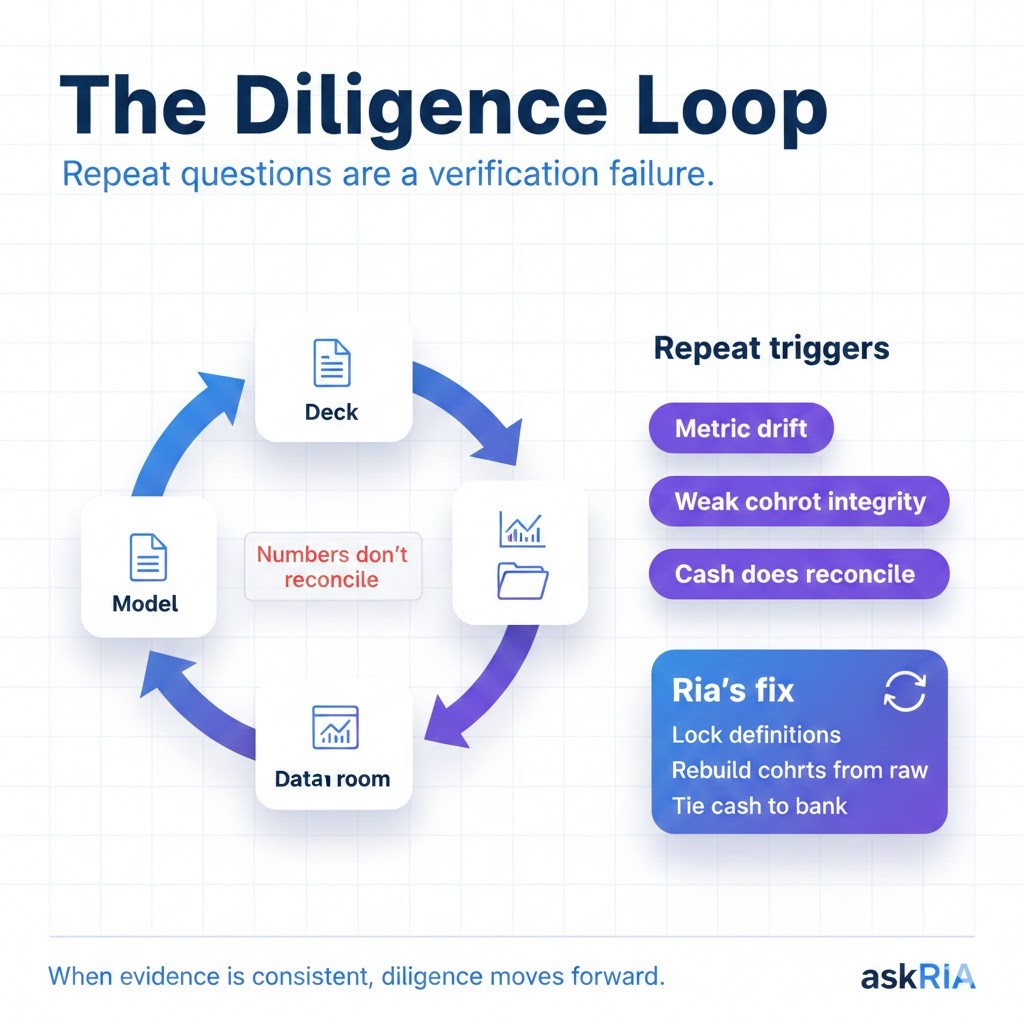
If your deck, model, dashboard, and data room disagree even slightly, every new question forces them to start over.
No investor takes inconsistent numbers into IC.
In most raises, the repeats come from three causes:
Metric drift
Weak cohort integrity
A cash story that does not reconcile
Each one forces an investor to ask the same thing again, because the prior answer was not stable. Fix these three and 80% of diligence friction disappears.
Repeat trigger 1: Metric drift
Metric drift is when the same KPI changes definition across places. Or the calculation changes without being stated. Or the time window shifts.
It shows up like this:
ARR in the deck does not match ARR in the model.
“Active customer” in the dashboard is not “active customer” in the cohort table.
CAC is presented as blended in one place and paid-only in another.
Churn is logo churn in one file and revenue churn in another.
Investors do not care that the number moved.
They care that it moved without an explanation.
A metric dictionary exists for a reason. If definitions are not locked, analysis is noise.
Repeat trigger 2: Weak cohort integrity
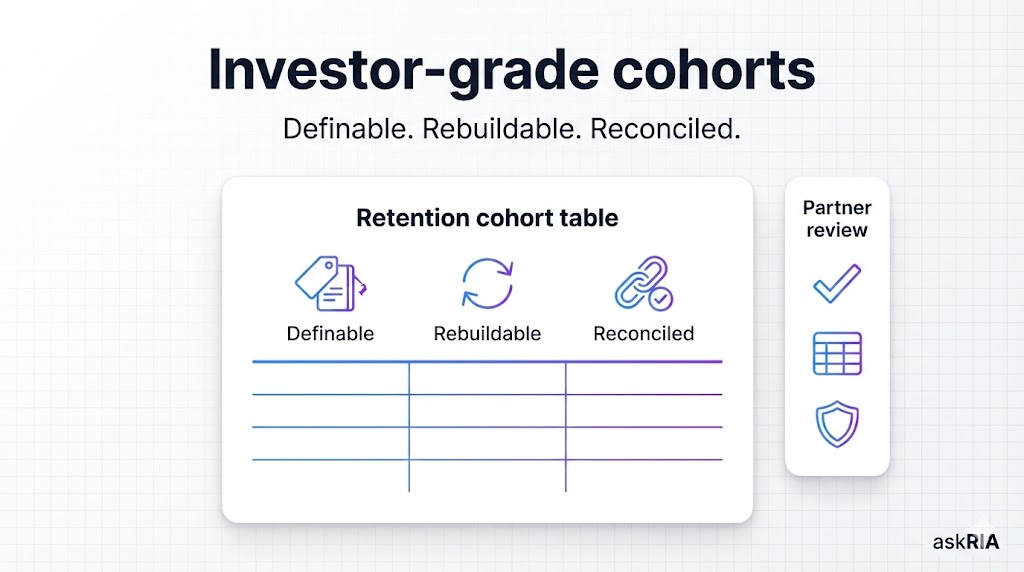
Cohorts are how investors decide if growth is durable. If the cohort construction is shaky, the entire growth story collapses.
Weak cohort integrity is rarely about the chart design. It is usually about the cohort construction:
Cohort date is inconsistent (signup date vs first payment vs activation).
Users move between cohorts due to backfills or migrations.
Expansion and contraction are mixed with retention without being labelled.
The cohort table cannot be rebuilt from raw exports.
If an investor cannot recreate your cohort logic independently, they cannot underwrite retention.
So they ask again.
Repeat trigger 3: Cash story does not reconcile
This is the fastest way to lose trust.
If the cash story does not reconcile, investors assume the model is decorative.
The basic checks are not optional:
Beginning cash plus net cash flow equals ending cash.
The three statements link properly under the indirect method.
Working capital assumptions are explicit and consistent.
Financing events (raise, debt) flow through cash and balance sheet.
Basic checks investors always run:
beginning cash + net cash flow = ending cash
burn matches runway
statements link correctly
financing flows through properly
No fund approves a deal with broken cash math.
What Ria checks
Ria does not start with storytelling.
Ria starts with reconciliation.
Because underwriting is math before narrative.
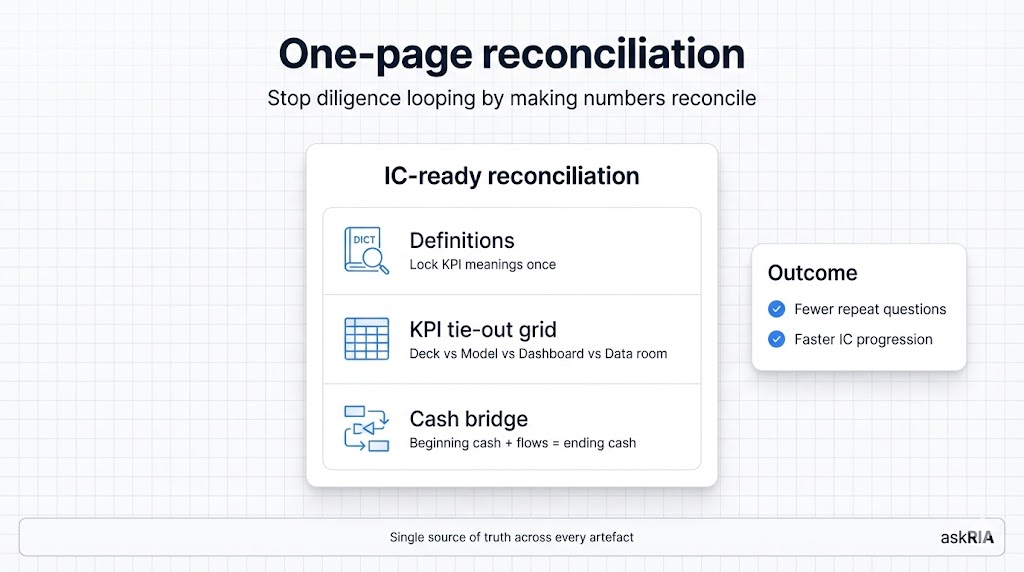
1) Metric dictionary lock
Ria builds a one-page metric dictionary and forces every KPI to have:
Name
Definition
Formula
Inclusion and exclusion rules
Time window
Source table or export
Owner
Then Ria checks the deck, model, dashboard, and updates against that dictionary. Any variance becomes a tracked change, not a silent shift.
2) One tie-out table across artefacts
Ria creates a tie-out grid: rows are KPIs, columns are artefacts (deck, model, dashboard, cohort sheet, update). Every cell must match or have a documented reason.
If an investor asks the same question twice, this table usually reveals why in under five minutes.
3) Cohort rebuild test
Ria rebuilds the cohort table from a raw export using the declared cohort date.
Ria checks:
Cohort date definition is consistent.
Retention is shown separately from expansion.
Refunds, pauses, and reactivations are treated consistently.
Totals reconcile to reported revenue and customer counts for the same period.
If the cohort cannot be rebuilt, Ria does not ship it.
4) Cash reconciliation and statement linkage
Ria runs a cash bridge:
Beginning cash
Cash from operations
Cash from investing
Cash from financing
Ending cash
Then Ria checks the links: net income flows into the cash flow statement and non-cash items and working capital adjustments are explicit.
5) Sensitivity on the actual breakpoints
Ria stress-tests the two drivers that typically break underwriting:
Retention (or churn)
CAC or sales cycle
Stress those.
Not ten scenarios. The two that actually change runway.
How to fix it
Use this order. Do not optimise formatting before the mechanics.
Freeze definitions
Publish the metric dictionary and stop silent changes.
Reconcile the headline KPIs
Pick 8–12 investor KPIs. Make them match everywhere or document the reason.
Rebuild cohorts from raw
Declare cohort date. Separate retention from expansion. Remove ambiguity.
Make cash balance
If cash does not tie, nothing else matters.
Ship a single “IC-ready” version
One folder. One model. One source of truth. No parallel numbers.
What changes in outcomes
When the loop stops, the investor questions change.
They move from:
“How are you calculating this?”
“Why did this number change?”
“Can you send the raw?”
To:
“What would you do with £X more runway?”
“What is the risk you are not pricing in?”
“What are the next two hires?”
That’s what conviction sounds like.
Calm. Specific. Forward.
Practical checklist
Copy this into your internal review before you send materials.
Metric drift
Do we have a metric dictionary with formulas and windows?
Do deck, model, dashboard, and updates match on the top KPIs?
Are changes logged, not silently replaced?
Cohorts
Is cohort date defined and consistent?
Can the cohort table be rebuilt from raw exports?
Are retention and expansion separated and labelled?
Cash
Does beginning cash plus net cash flow equal ending cash?
Do the statements link properly?
Are working capital and financing assumptions explicit?
Before sending your next deck, ask Ria to run a readiness check. She reconciles the numbers, flags the gaps, and tells you exactly which two issues will keep diligence repeating.
FAQs
What does “come back later” usually mean in practice?
It usually means the investor cannot take the deal into IC because the numbers are not stable across materials, or the evidence trail is incomplete.
Why do investors repeat questions instead of moving on?
Because they are testing whether answers are verifiable. If the underlying definition or table is unstable, the prior answer is not usable for underwriting.
What is metric drift in fundraising?
Metric drift is when a KPI changes definition, time window, or calculation across artefacts, creating inconsistencies that force rework.
What makes a cohort table “investor-grade”?
A consistent cohort date, that can be rebuilt from raw data, and clear separation of retention from expansion so the mechanism can be checked.
What is the fastest cash check investors rely on?
Cash reconciliation: beginning cash plus net cash flow equals ending cash, with statements linked so runway and burn are credible.