seed-round
investor-tips
How to Build an Investor Data Room (checklist-structure-examples)

Adhrita Nowrin
Mar 31, 2026
An investor data room is a structured set of legal, financial, and operational documents used during due diligence. A good data room doesn’t list documents. It proves the business holds up under diligence.
We've reviewed hundreds of data rooms over the past two years. From founder-built rooms on Google Drive with 20 files named "final_v3" to rooms built on DocSend with tracking enabled but no actual structure and have reached one conclusion.
The data room is where fundraising momentum either holds or collapses, not because founders don't know what documents to include: every guide on the internet lists the same 15 things. The problem is that most founders have no idea whether their room is actually ready for an investor to open it and understand their story.
This post is for founders raising Pre-seed through Pre IPO. We cover the folder structure investors expect, the documents that matter at each stage, and the specific points where most data rooms fall apart under diligence. We also show exactly what happens when a founder builds a data room on askRIA instead of assembling one manually.
Where the data room sits in a fundraise
Founders sometimes treat the data room like a first impression. At seed stage, the sequence goes: deck, meeting, follow-up call, then data room. The investor has already decided they're interested before they ask for the room. A study by TDK Ventures and 6Pages across 700 VC firms found that a typical deal takes 83 days to close, with VCs spending an average of 118 hours on diligence and calling roughly 10 references.
The deck sells the vision. The data room proves it holds up under scrutiny.
That distinction matters because it changes what the data room needs to do. It's not a pitch. It's an evidence file. Every document in it should answer a question the investor is going to ask, before they ask it.
Investor Data Room Checklist: The 8 Folders Investors Expect
We've standardised this across the companies that use askRIA. Most data room templates online list 15 to 20 categories. At pre-seed to series A, 8 cover what investors actually look at. If a specific investor requests more, add it accordingly.
1. Corporate and legal. Certificate of incorporation, articles of association, board resolutions, statutory filings. For companies operating across jurisdictions (UK/UAE/US is common at our stage), each entity's formation documents go in separate sub-folders. Bundling three jurisdictions into one PDF is a flag. Investors want to see clean corporate structure. If there's a holding company, show the org chart.
2. Cap table and equity. Current cap table with all shareholders, ESOP pool allocation, convertible notes, SAFEs, and any warrants. This is the single most scrutinised document in the room. The numbers here must match the numbers in the deck. Carta's data room guidance calls cap table inconsistencies one of the most common diligence red flags. We see this constantly: the deck says the founder holds 62%, the cap table shows 54% because an advisor's shares were never recorded. That discrepancy kills trust.
One spreadsheet with linked tabs. Update it the day a SAFE converts or a new grant is issued in real time.
3. Financials and tax. Monthly P&L, balance sheet, and cash flow statement for the last 12 months minimum. A forward-looking financial model with 24 to 36 months of projections. Andreessen Horowitz's data room guide is specific about this: show the path from gross revenue through net income through cash outflow on a monthly basis. At seed, audited financials aren't expected. But the model needs to be internally consistent and the assumptions need to be defensible.
Investors will check whether MRR in the model matches MRR in the customer data. If those numbers are off, the conversation stops.
4. Business and strategy. The pitch deck, a one-page executive summary, and the investment memo if one exists. Andreessen Horowitz recommends having the data room ready before kicking off the raise because assembling it forces founders to pressure-test their own numbers. That's good advice. The data room should make the founder more prepared for the pitch, not less.
5. Product and IP. Trademark registrations, patent filings if applicable, domain ownership records, and IP assignment agreements. This last one matters more than most founders realise. If core technology was built by a contractor before incorporation, or by a co-founder in a personal capacity, the IP assignment must be signed and filed. Ellty's due diligence cost analysis found that IP ownership gaps are one of the biggest sources of legal cost during seed rounds, sometimes adding £5,000 to £15,000 in lawyer hours to resolve mid-diligence.
Fix this before the raise.
6. Customers and revenue. For SaaS: a blind customer list with contract start date, current MRR, segment identifiers (geography, vertical), and churn data. For marketplace or e-commerce: transaction volume, AOV, and retention cohorts. Abacum's Series B data room guide recommends including raw customer MRR data with segment identifiers so investors can run their own analysis. At every stage, a summary table with 6 to 12 months of data is enough. The Crowdwise angel investing study found that startups providing organised customer data during diligence achieved 7.1x returns for investors, compared to 1.1x for those spending less than 20 hours on preparation.
7. Team and HR. Org chart, co-founder bios, key hire profiles, employment agreements, ESOP grant details, and the co-founder agreement. If there is no co-founder agreement, that is a flag investors notice on the first pass, include vesting schedules.
8. Compliance and regulatory. Tax filings (corporation tax, GST/VAT returns), data protection documentation (GDPR for UK/EU, DPDP for India), industry-specific licences. For Indian startups: PF, ESI, professional tax registrations. For UAE entities: ADGM or DIFC compliance documentation. For US C-Corps: state filings and 83(b) elections if applicable.
Every document in the room should be current, final, and accurate.
The naming convention that saves real time
A VC-led seed round involves 20 to 50 documents reviewed by 2 to 4 people on the investor's side. If files are named "IMG_4892.pdf" or "Financials_FINAL_v3_updated_REAL.xlsx," someone on the investor's legal team spends an hour just sorting out what they're looking at. Multiply that frustration across 6 investors reviewing the room simultaneously, and momentum bleeds out.
Format: [FolderNumber] - [DocumentType] - [Date]
01 - Certificate of Incorporation - 2024-03.pdf 03 - Monthly PnL - Jan to Dec 2025.xlsx 06 - Customer MRR Summary - Q1 2026.xlsx
Number the folders. Name the files. Date everything. This is basic operations discipline. It signals that the company is run properly.
When askRIA builds the data room instead
Everything above assumes the founder is doing the work manually. Choosing a platform, creating folders, naming files, cross-checking documents against a template, and hoping nothing is missing when the investor opens the room. That process takes most founders 15 to 25 hours according to due diligence preparation estimates from Ellty and DealRoom.
askRIA eliminates that work and saves weeks of time for founders. Here's what actually happens when a founder uploads documents to the platform:
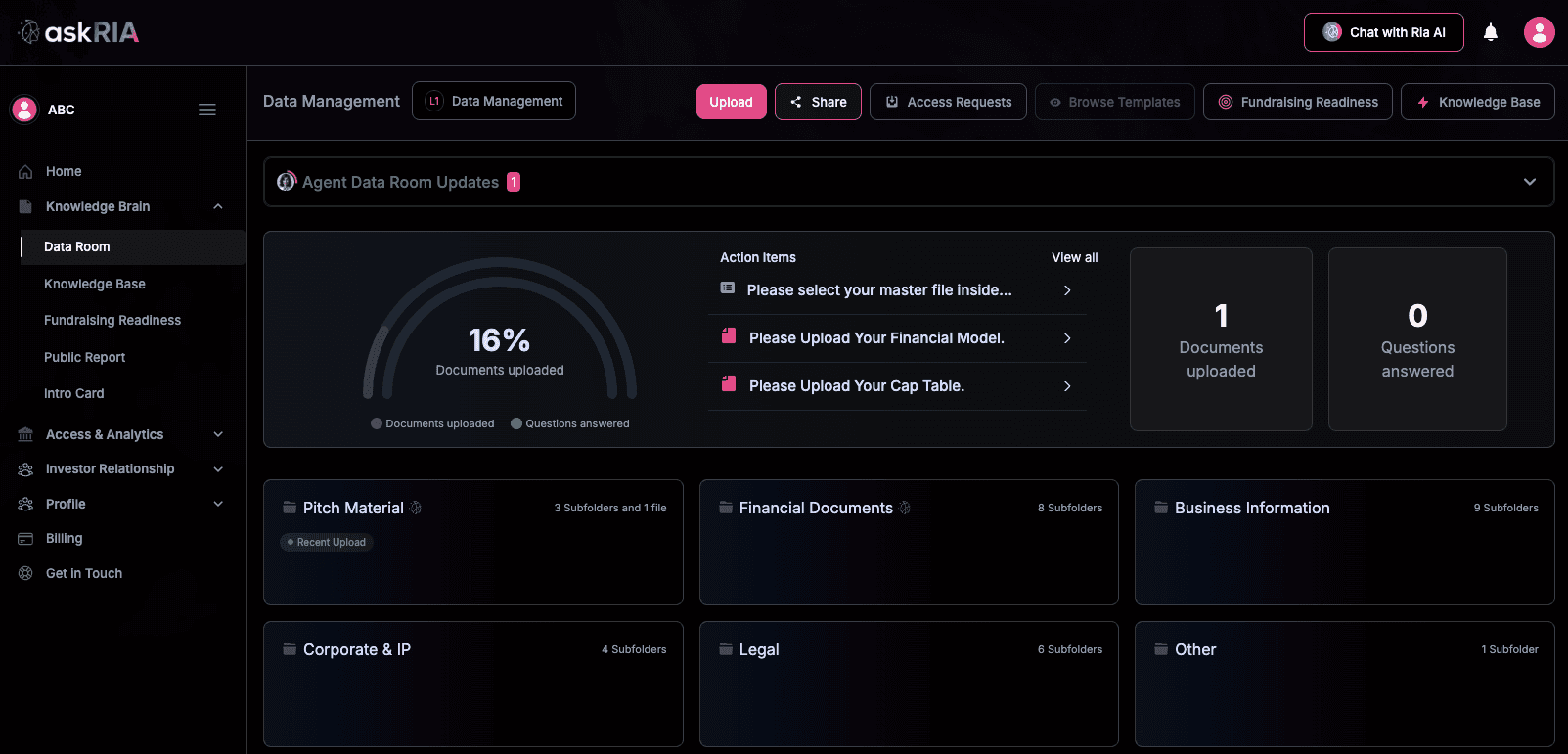
Automatic structuring. The founder uploads documents in any format, in any order. askRIA reads each one, classifies it (financial statement, cap table, incorporation certificate, employment agreement), and organises it into the correct folder in a structured data room. No manual sorting. No renaming files. The 8-folder structure described above gets built automatically from whatever the founder uploads.
Gap identification. Once the room is structured, askRIA scans for what's missing. Cap table uploaded but no ESOP schedule? Flagged. Financial projections without a cash flow statement? Flagged. IP folder has a trademark filing but no contractor assignment agreement? Flagged. The founder gets a specific list of missing documents, not a generic checklist.
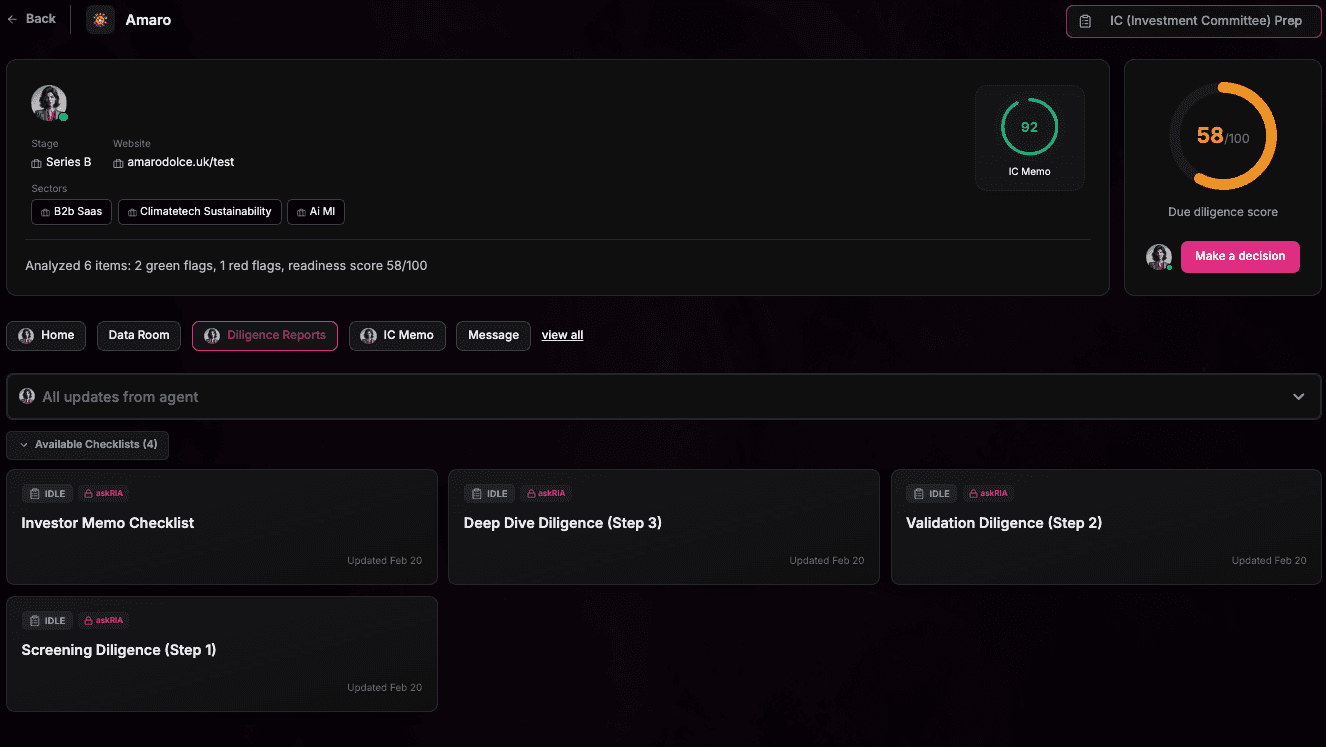
Red flags and green flags. askRIA reads the uploaded financials, cap table, and legal documents and flags specific issues. Revenue in the model doesn't match the customer MRR data. The ESOP pool exceeds the board-approved allocation. A key employment agreement is unsigned. These are the exact issues that investors catch in the first 30 minutes of diligence. askRIA catches them before the room is shared.
Investor Readiness Score. A single number, scored out of 100, that tells the founder how close the data room is to being diligence-ready. Not a vanity metric. A diagnostic built from document completeness, internal consistency across files, and red flag severity. A founder scoring 72 knows exactly what to fix to get to 90 before sharing the room.
Investor CRM and analytics. Once the room is live and shared, askRIA tracks which investors viewed which documents, time spent per document, and which sections generated the most engagement. The founder can see that Investor A opened the financial model 4 times but hasn't looked at the team section. That's actionable intelligence for the follow-up conversation.
Investor outreach. askRIA analyses the company's thesis, sector, stage, and geography and identifies investors whose criteria match. Founders can initiate outreach directly from the platform, with the data room already structured and scored before the investor opens it.
The difference between assembling a data room on Google Drive and building one on askRIA is the difference between filing paperwork and running a fundraise with infrastructure behind it. One is a folder. The other is an operating system for the raise.
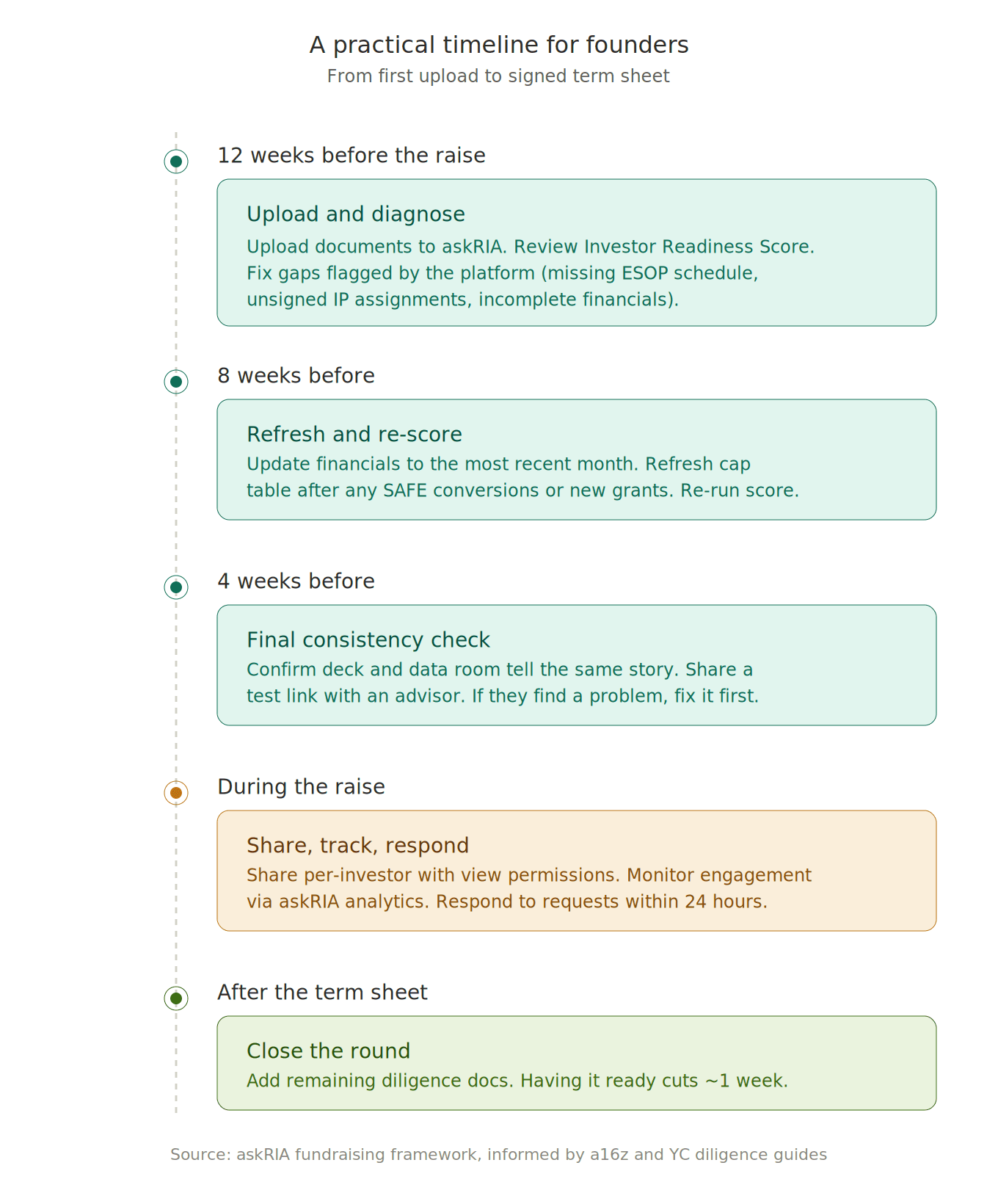
A practical timeline for founders
5 red flags investors catch in the first 10 minutes
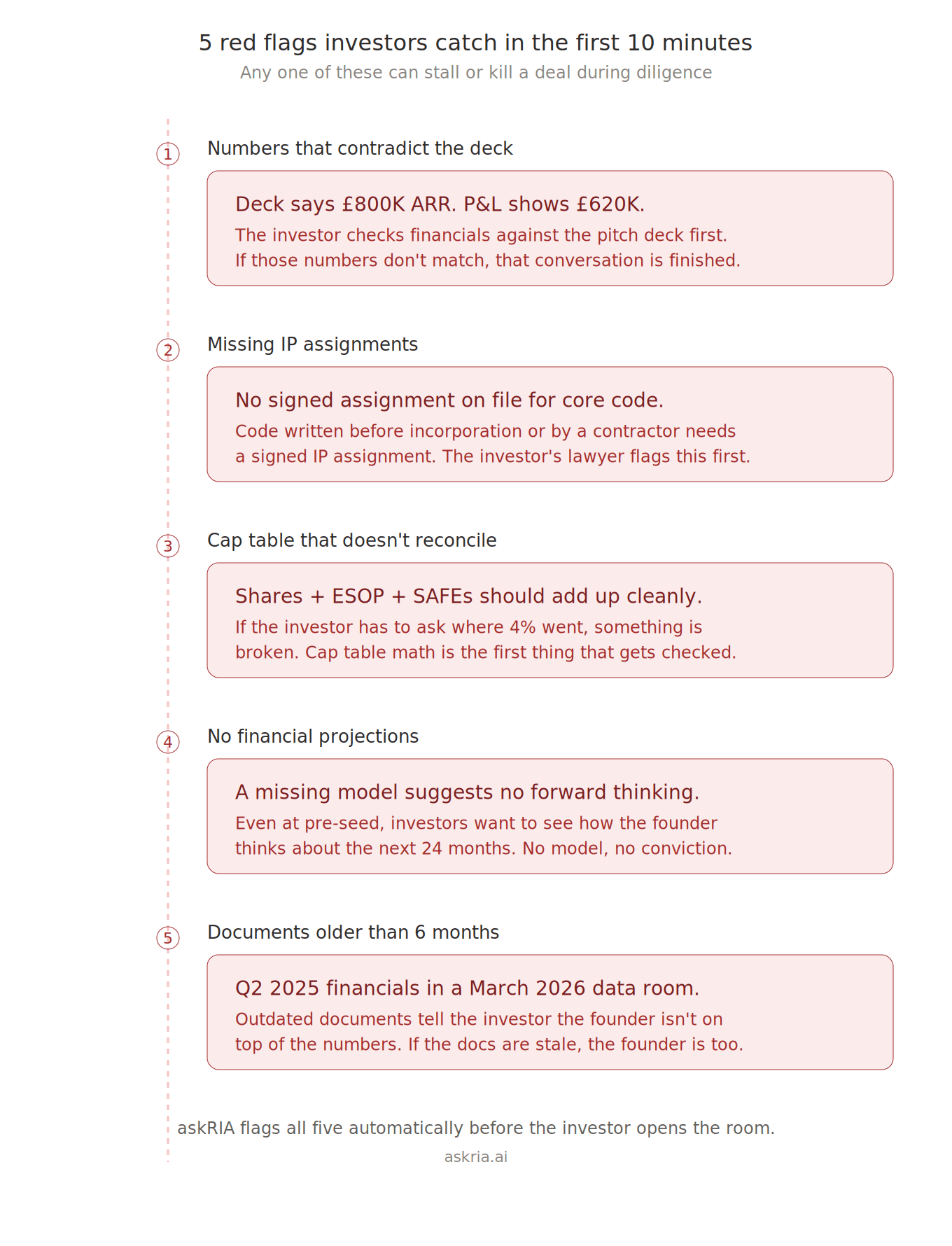
1. Numbers that contradict the deck. The deck says £800K ARR. The P&L shows £620K. That conversation is finished before it starts.
2. Missing IP assignments. Core code was written before incorporation or by a contractor, and there's no signed assignment on file. The investor's lawyer flags it on the first review.
3. Cap table that doesn't reconcile. Shares outstanding plus ESOP pool plus SAFEs should add up cleanly. If the investor has to ask where 4% went, something is broken.
4. No financial projections. Even at pre-seed, investors want to see how the founder thinks about the next 24 months. A missing model suggests the founder hasn't modelled the business.
5. Documents older than 6 months. Financials from Q2 2025 in a March 2026 data room tells the investor the founder isn't on top of the numbers. If the documents are outdated, the investor assumes the founder is too.
Platform comparison for data room
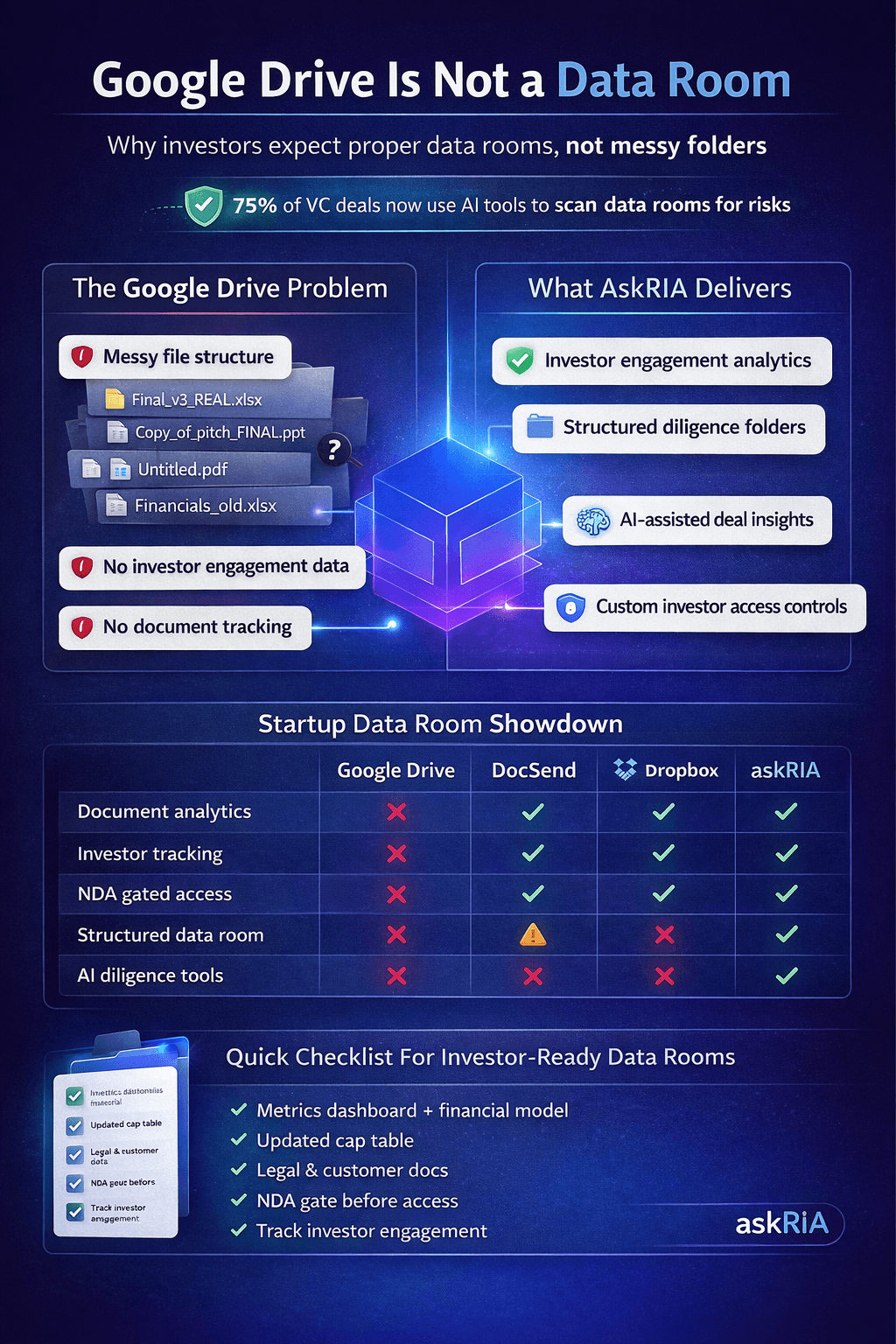
Google Drive works for a well-organised founder with 20 documents and one or two investors but it’s fundamentally a storage tool, not a diligence system. (Full breakdown: Google Drive vs investor data rooms →). Carta offers free data room functionality tied to its cap table management. DocSend and Papermark provide document sharing with view tracking. Visible.vc packages data rooms with investor update tools.
All of these are file sharing platforms with varying levels of analytics. The founder does the structuring, gap-checking, naming, and consistency verification by hand.
askRIA is not a file sharing tool. It's infrastructure. Automatic structuring. Gap identification. Red and green flag analysis. Readiness scoring. Investor CRM with document-level analytics. Outreach matching. The founder uploads documents and gets a diligence-ready data room with a score and a fix list. The difference compounds with every investor who opens the room.
FAQs
What is an investor data room? An investor data room is a secure digital repository where founders store and share the legal, financial, and operational documents that investors review during due diligence. It typically includes incorporation documents, cap tables, financial statements, customer data, IP filings, employment agreements, and compliance records.
When should a startup build a data room? Before starting the fundraise. Founders who maintain data rooms continuously spend 2 to 3 hours per quarter on upkeep. Founders who build from scratch during diligence spend 15 to 25 hours under time pressure, and that's before the investor asks follow-up questions.
What documents do seed-stage investors expect? The 8 core categories: corporate and legal, cap table and equity, financials and tax, business and strategy, product and IP, customers and revenue, team and HR, and compliance. Specific requests vary by investor, but these categories cover the large majority of seed diligence.
How is askRIA different from Google Drive or DocSend for data rooms? Google Drive is a file storage platform. DocSend is a document sharing tool with analytics. askRIA automatically structures uploaded documents into a data room, identifies missing documents, flags red and green flags in financials and legal documents, generates an Investor Readiness Score, provides a CRM for tracking investor engagement at the document level, and matches the company with relevant investors for outreach. It's diligence infrastructure, not file hosting.
What red flags do investors look for in data rooms? The five most common: numbers in the data room that contradict the pitch deck, missing IP assignment agreements, cap table inconsistencies, absence of financial projections, and outdated documents. These are the issues that slow down or terminate diligence.
How long does due diligence take at seed stage? A well-prepared seed round with a clean data room typically closes diligence in 2 to 4 weeks. Complex situations (cap table errors, missing IP documentation, unsigned agreements) can stretch to 8 weeks or longer. TDK Ventures data across 700 firms shows the average deal takes 83 days to close including negotiation.
Does askRIA work for multi-jurisdiction startups? Yes. askRIA handles data rooms for UK (Companies House filings, HMRC documentation), UAE (ADGM/DIFC compliance), US (Delaware C-Corp documentation, state filings), and India (MCA filings, GST, PF/ESI). Multi-entity structures are supported with separate sub-folders per jurisdiction.
Try askRIA free for 15 days this April
We're opening a 15-day free trial for founders. If you’re raising in the next 6 months, this is the difference between a 2-week diligence and a 2-month one.
→Upload your documents, see your Investor Readiness Score, and find out what to fix in your data room before your next investor conversation.
Email hello@askria.ai to build your data room at askRIA.
Or book a free 20-min fundraising readiness call → Calendly link