due-diligence
investor-tips
seed-round
startup-metrics
unit-economics
What Metrics Do Investors Actually Care About in a Seed Round?

Adhrita Nowrin
Jan 20, 2026
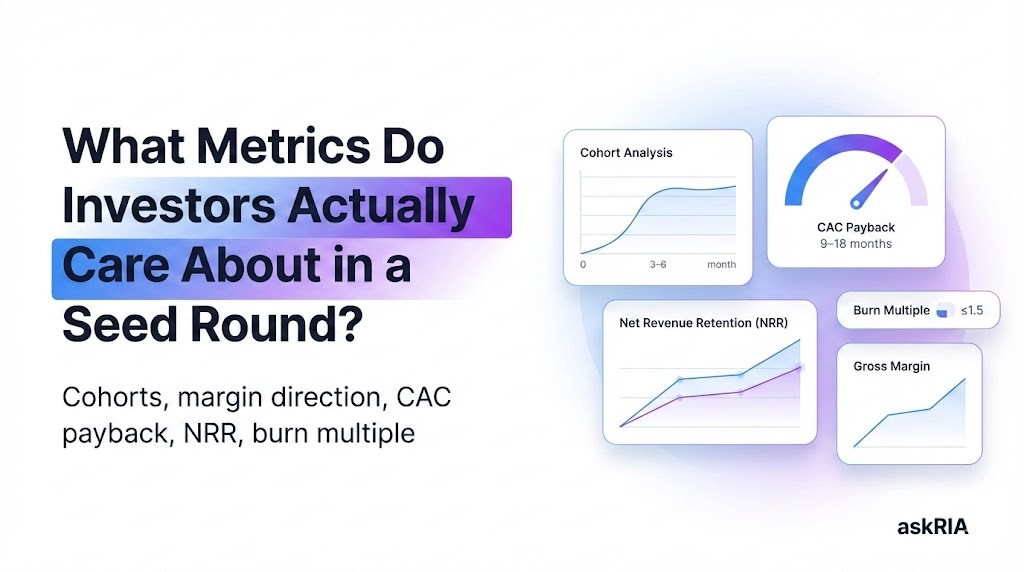
At seed, investors consistently anchor their decision on five signals that predict survivability and speed to Series A: cohort retention shape, gross margin direction, CAC payback corridor, net revenue retention, and burn multiple, all reconciled to source data.
Key facts:
Pre-PMF CAC payback typically falls in a 9 to 18 month corridor if the business has a credible path to improvement.
Cohorts should stabilise by months 3 to 6, with expansion appearing after real product milestones, not in month one.
Gross margin should hold or improve on newer cohorts as usage scales, based on true cost to serve.
NRR quality matters more than top-line growth at seed.
A burn multiple under 1.5 is strong in tight markets when growth quality holds.
Definitions and formulas:
Cohort retention shape: Active or revenue retention by month for a starting cohort, including expansion timing and promotion flags.
CAC payback (months): Customer acquisition cost ÷ monthly gross profit generated by that cohort.
Gross margin: (Revenue − cost to serve) ÷ revenue.
NRR: (Starting cohort revenue + expansion − churn − contraction) ÷ starting cohort revenue.
Burn multiple: Net burn ÷ net new ARR or net new gross profit over the same period.
Seed rounds are noisy. When story is stripped away, these five metrics tell investors whether a company’s engine can compound or whether it is being temporarily propped up.
1) Cohort retention shape
What investors read
Stabilisation by months 3 to 6.
Expansion appears after product milestones, not immediately.
Discounted or incentive-heavy cohorts are labelled and analysed separately.
Quick test
Chart two or three recent cohorts. If the curve continues to slide every month, quality is weak regardless of top-line growth.
2) Gross margin direction
What investors read
Margin holds or improves on newer cohorts at current mix.
Cost to serve is mapped to plans or SKUs, including cloud, data, payments, and support.
Quick test
Tie vendor invoices to usage by plan. Identify step-ups that flatten margin as customers scale.
3) CAC payback corridor
What investors read
Latest quarter only
Calculated by channel.
Payback between 9 and 18 months pre-PMF, with a visible route to fasten it.
Quick test
Rebuild payback from source invoices and cohort gross profit over the first 6 to 9 months. Exclude heavy promotional effects.
4) Net revenue retention
What investors read
Expansion driven by usage or value, not discount roll-offs.
At least one segment shows healthy retention without incentives.
Quick test
Compute NRR on the two most recent cohorts. Expansion should lag activation and support load, not lead them.
5) Burn multiple
What investors read
Efficiency and growth in one lens.
Sub 1.5 is strong when growth quality holds.
Quick test
Quarterly net burn ÷ net new ARR. If revenue is noisy, use net new gross profit.
Cross-checks investors should require
Definitions locked: ARR, MRR and bookings consistent across deck, model and updates, with cash vs accrual clearly stated.
Cash tie-out: Bank balance, invoices and processor statements reconcile to reported numbers.
Channel mix: CAC and payback by channel, with no single channel driving more than half of new ARR.
Lineage: Headline metrics trace cleanly to underlying sources.
Red flags that warrant a pause
No cohort view for a subscription or usage model recurring revenue model.
Payback under six months on paper driven by month one upsell.
Margin collapses at higher usage or when safety filters are on.
Burn multiple improves only because growth slowed.
Blended CAC stable flat while channel mix shifts materially.
What “good” looks like at seed
Cohorts that flatten by months 3 to 6 with measured expansion.
Gross margin that holds or improves as customers scale.
Payback in corridor with credible tests to shorten it.
NRR improving on newer cohorts without heavy discounting.
Burn multiple trending down without sacrificing growth quality.
FAQs
1) Which metric do investors check first?
CAC payback rebuilt from source data. It exposes promotion dependence and margin fragility quickly.
2) How many cohorts are enough at seed?
Two or three recent cohorts are sufficient to see shape and discount effects.
3) What if cohorts are very young?
Use early curves plus qualitative indicators such as renewal intent and support burden, then re-test monthly.
4) Do vanity metrics matter at seed?
No. Investors prioritise cohort shape, margin path, payback by channel, NRR, and burn multiple tied to evidence.